
Strategy September 25, 2026
PRINTING United Expo 2026: Print & Promo Leaders Take Stock
AI adoption, changing customer habits and future growth were among the topics explored during a Thought Leadership Breakfast fireside chat and subsequent panel discussion.
Key Takeaways
• Print and promo companies are positioning themselves as one-stop marketing partners.
• Industry leaders are using AI to improve design, inventory planning and efficiency.
• Buying habits are shifting toward lower-cost decoration, on-demand ordering and company stores.
Becoming the largest supplier in the promotional products industry doesn’t happen overnight.
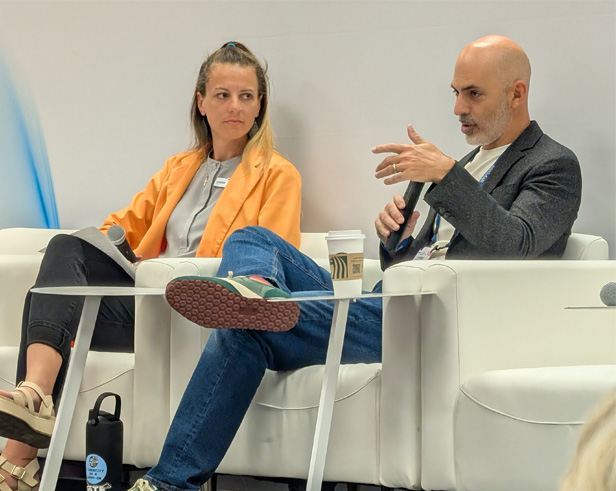
Apparelist Content Director Cassie Green talks with SanMar (asi/84863) CEO Jeremy Lott during a Thought Leadership Breakfast at PRINTING United Expo in Las Vegas on Thursday.
“Sometimes people ask me, ‘How did you guys get so big?’” said SanMar (asi/84863) CEO Jeremy Lott, who earned the top spot on the 2025 Counselor Power 50 list of the most influential people in promo. “It took 55 years, and [we] grew really slowly over a long period of time.”
Speaking with Apparelist Content Director Cassie Green at a fireside chat during PRINTING United Expo at the Las Vegas Convention Center on Thursday, Sept. 24, Lott explained that when his father started the apparel basics company in 1971, the philosophy was always to reinvest back into growing the business. And Lott has continued that tradition, taking a thoughtful, measured approach to technology adoption while keeping humans at the heart of the company.
The secret to ongoing success? “We have to do lots of little things right every day, and we’re really committed to that,” Lott added.
Lott also shared his thoughts on strategic use of AI, supply chain resilience, succession planning and other topics in a talk that segued into a larger panel discussion, featuring leaders in the promotional products and printing industries, moderated by Michele Bell, ASI senior vice president of editorial, education and global alliances. The invitation-only Thought Leadership Breakfast explored what’s changing in the converging worlds of print and promo, where opportunities exist for each and how the industries can move forward together.
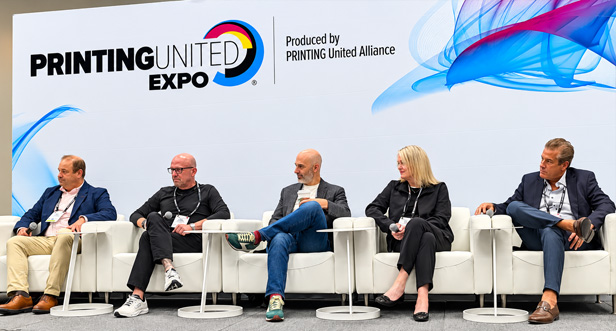
From left: Justin Zavadil of Counselor Top 40 distributor ASB (asi/120075); Shaun McCardell of MACS Companies; Jeremy Lott of SanMar (asi/84863); Wendy Knapp of Quad (asi/232306); and Joe Falcone of Counselor Top 40 distributor The Sourcing Group (asi/330100).
In addition to Lott, Bell spoke with Wendy Knapp, vice president of branded solutions at Quad (asi/232306); Shaun McCardell, owner of apparel decorating firm MACS Companies; Justin Zavadil, president of Counselor Top 40 distributor ASB (asi/120075); and Joe Falcone, chief operating officer of Counselor Top 40 distributor The Sourcing Group (asi/330100).
Becoming a One-Stop Shop
The panelists had different approaches to selling print and promo, with some selling equal amounts of each and others just beginning their journey. Though it’s known primarily as a print company, Quad has “evolved into one of the largest marketing experience companies in the world, and we’ve done that by keeping our experts where they are,” Knapp said. Rather than training print reps to sell promo, Quad hired seasoned promo talent when it branched into the logoed merchandise space, she added.
For The Sourcing Group, however, “a relationship is a relationship,” said Falcone, adding that print-focused reps don’t necessarily need to know about promo, and vice versa. “You need to know the relationship.”
Despite those differences, they each strive to take an agency approach, becoming a one-stop solution shop for clients. For example, Quad worked with a company that pitched a life-extending dog food to Costco, which loved the concept. There was just one problem. “They had no logo, no design, no concept, no packaging, no nothing,” Knapp said.
Using extensive consumer data and every division in the company working in tandem, Quad had about 90 days to help create a cohesive solution for Heckova dog food, encompassing marketing, packaging, a distribution model and logoed merchandise. It was a textbook example of how print, packaging and promo can work together seamlessly.
Strategic AI Adoption
Panelists also discussed how their companies were incorporating AI and automation tools to build efficiencies. Lott said SanMar, for example, is working on building an AI-powered program that can help track changes in customer behavior in real time, sharing insights on things like popular colors and styles to help the team make better inventory decisions.
McCardell said AI has been a boon for his design department, allowing them to come up with visual concepts more easily and hand them over to an artist to finalize, rather than the “back-and-forth for three weeks” that might happen without generative tools. A human is still essential, however, to ensure that the artwork is optimized for print.
Indeed, each panelist agreed that prioritizing people was key. “We’ve made a conscious effort that we’ll lead from our hearts,” Zavadil said. “AI doesn’t have a heart. So, you want to use it to make things more efficient, but not to replace those important people, the culture.”
Changing Buying Habits
McCardell, who has a clothing line that sells into the resorts market, has seen an increase in price sensitivity when it comes to decorated apparel. “Three years ago, I could sell a shirt in the wholesale market for $17,” he said. “Now, everybody wants one for $6.99.”
Instead of complex and more lucrative decoration techniques – like high-end appliqué – clients are more likely to opt for simpler, less expensive methods. He attributed it to consumers still taking their vacations, but spending less on souvenirs, with rising fuel prices cutting into budgets.
On the corporate side, on-demand ordering models and online company stores continue to gain ascendance. Rather than ordering higher quantities of individual items and warehousing them, McCardell said, the big customers want a website built so they can pick out mugs, hats, pens and other branded goods in smaller batches.
ASB, too, has had traction with company stores. “We’re seeing more volume growth, but way more transactions,” Zavadil said. “We’re processing thousands and thousands of transactions a month, and that’s only growing.”
What’s crucial, though, is the efficiency on the back end to ensure those low-quantity, high-volume transactions are still profitable, he added.
What Comes Next
Panelists also shared some of the developments they’re most excited about for the future.
Lott plugged the launch of MiiR apparel in the summer. “Taking a piece of drinkware and imagining it as a jacket is a really interesting kind of challenge, and our team did an unbelievable job,” he said.
Lott also acknowledged the risk of his formerly apparel-only company branching out into hard goods when it adds MiiR drinkware in early 2027, but added that advancements in decorating technology prompted the decision. “We felt like there were enough customers who had laser engraving, pad printing or other equipment that they could decorate the product,” he said. “Why wouldn’t they buy it from us?”
Knapp said Quad is most excited about increasing the relatively new promo side of its multibillion-dollar business, planning to tap into its 2,100 existing accounts, but also aggressively pursuing new business.
“That’s where we see the biggest growth for us, with our branded solutions division,” she said. “We haven’t even scratched the surface yet.”