Strategy CANADIAN NEWS July 22, 2026
ASI Show Chicago 2026: Education Day Brings Technical Insight & Personalized Advice
During the day’s Wrap-Up session, speakers reiterated their insights on how promo pros can differentiate themselves from the competition and attendees were asked about their businesses during real-time polling.
Key Takeaways
• Education Day at ASI Show Chicago emphasized that technology like AI, ESP and print-on-demand should automate routine work while allowing distributors to focus on personalized service and creativity.
• Speakers encouraged distributors to specialize in defined niches, research prospects thoroughly and tailor outreach to specific customer pain points instead of relying on generic sales approaches.
• Print integration, scalable merch programs and functional, lifestyle-oriented products were highlighted as key opportunities.
Education Day at ASI Show Chicago this week was packed full of useful insights, success stories and new product information.
Following a full schedule of education sessions, each of the featured speakers took the stage, joining ASI’s Stephanie Turner-Scott and Michele Bell to give concise rundowns of everything they spoke about during the information-rich day. Attendees were also asked about the state of their businesses and the industry during live polling.
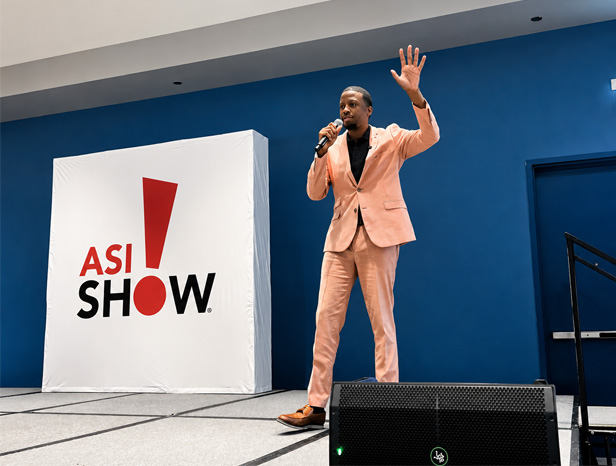
During the Education Day Wrap-Up, Sterling McKinley of Clarity AI Solutions speaks about using AI thoughtfully in business and the human work that must go into it.
Speaker Sterling McKinley of Clarity AI Solutions began the event with a level-headed take on the AI revolution. In short, he said, AI is just like every other technological innovation that has come down the pike throughout history. “They said the internet was going to destroy everything,” he added. “Did things change? Yes. But it’s still here.”
He stressed that AI is only as good as the person using it, as any tool is. It requires practice over time to perfect the art and still requires the human touch to iron out any robotic errors that might pop up in the process.
Following McKinley, Mary Furto, senior vice president of marketing for Counselor Top 40 supplier PCNA (asi/66887), focused on fourth-quarter selling trends and popular products for holiday gifting.
Across different verticals such as travel, wellness, golf and apparel, Furto connected themes like elevated perceived value from name-brand products and using items for human (and animal) connection. She also cited the rise in golf as a leisure activity for de-stressing.
Regardless of the item, the lesson she relayed is that a product must accomplish the task of improving the recipient’s life in some real way.
“It’s not about being expensive, but intuitive and functional,” Furto said. “Consumers are choosing products that reflect how they’re actually living.”
In the first real-time poll question, attendees were asked, “Will your 2026 sales exceed your 2025 sales?” The majority responded that they expect their 2026 sales will eclipse last year’s, with a whopping 82% feeling optimistic.
To help distributors ensure their sales continue to increase, Kevin Baumgart of Sales Ink (asi/513151) delivered advice for creating measurable systems for customer identification and acquisition.
One of the first steps is to look at tasks and ask yourself whether you or someone at your business is stretching themselves too thin and looking for places where you can optimize tasks by dedicating different staff to these jobs.
Another common mistake he sees among businesses is that they’re trying to be all things to all customers, rather than identifying a niche or specialization. Once you have that, go even further by personalizing your messaging and touchpoints and identifying customers’ specific pain points, rather than a cookie-cutter sales email or cold call.
Turner-Scott and Bell than asked attendees whether they consider items such as concert tees and sports merchandise to be “promo products.” The results were once again overwhelming, with 80% of attendees saying yes, and 20% saying no.
Following the survey, PRINTING United Alliance’s Denise Gustavson dove into the concept of traditional print and discussed how it can fit into a promotional products distributor’s business plan.
While it can seem intimidating, she said, a distributor doesn’t have to know the ins and outs of the technical side of print, just like a car salesman doesn’t have to know how to do some complicated maintenance on a race car. The salesperson simply needs to understand how the print product they’re selling would benefit their customer.
“Selling print with confidence isn’t about tech expertise,” Gustavson said, “it’s about guidance. Your customers trust you and bring their promo needs to you. But they go to someone else for print. Once you combine print and promo, both of those allow you to be much more profitable and you become much stickier with the customers you have.”
The next poll question asked the audience whether they anticipate print on demand (POD) to be a growing part of their business in 2026, with 68% responding yes, 20% no, and 12% unsure as to what exactly the technology is.
Dave Conner from Stahls’ (asi/88984) explained that POD lets a distributor change one-off orders into larger merchandise programs that drive recurring revenue and therefore deepen a client relationship. The easiest way to describe it, Conner said, is where production meets demand in real time.
As its name indicates, a product like a T-shirt or drinkware piece is printed corresponding with demand, often through an e-commerce platform or at a live event.
“POD turns one-off orders into scalable systems, and changes the mindset from job-based to programs with repeat revenue,” Conner said
John Young, director of software engineering at ASI, also spoke to attendees about how ESP can help them in their business by saving them time just like an AI tool might.
“Spend your time doing the thing that makes you uniquely valuable to your clients,” Young said. “Saving time makes closing deals and making more money faster, easier and more fun.”
Young highlighted the myriad tools within ESP+, such as the robust product search and built-in CRM system, that can help a distributor remove some of the busy work from their business and focus on the things that make them valuable to their customers – their creativity, their perceptive ability to pick up on trends and pain points, and beyond.
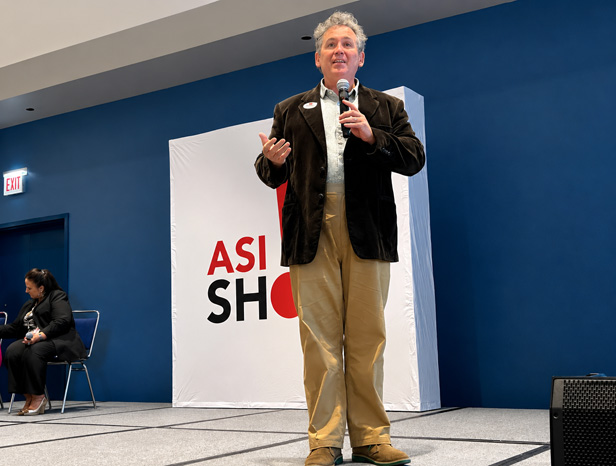
John Young, director of software engineering at ASI, highlights essential features in ESP+.
Reflecting what Young said about focusing on the human side of the business, Jason McCracken of Counselor Top 40 distributor BAMKO (asi/131431) explained how a distributor can set themselves apart from the crowd through more researched approaches and human appeal. This can mean doing a little extra homework to find the right person to reach out to.
“Just because someone is the VP of marketing doesn’t mean they know anything about the 500 T-shirts you’re trying to sell them,” McCracken said. “It’s not in their scope. Find the right person.”
The event ended with Shawna Suckow from The Buyer Insider, who spoke on the topic of finding the right customer and understanding your business’ place in the industry.
“Small businesses compete in the same sandboxes with giant companies, and you can’t win in that sandbox,” she said. “You can’t be the cheapest consistently or have the budgets they have for marketing or the teams they have. So, you have to create your own sandbox, and you do that by humanizing yourself. They’re not buying your widget; they’re buying from you. That’s why you can’t sell on price or simply the strength of a product if it’s also being sold by so many others.”
In the final poll question, 48% of attendees said they were most excited to use ASI Show Chicago as a means of finding new products, 28% said finding new suppliers and creating new connections, and 24% said networking with other promo pros. Of course, as Bell joked, if there had been an “all of the above” option, that might have taken the lion’s share of responses.