
Printing CANADIAN NEWS April 20, 2026
Kornit Konnections Presenters Make the Case for Moving to Print on Demand
The annual conference drew more than 550 professionals to discuss the future of apparel production and digital decoration.
Key Takeaways
• Apparel decoration equipment company Kornit Digital hosted the fourth annual Kornit Konnections, a conference dedicated to the future of apparel production and decorating.
• Print on demand and digital production are becoming essential in a volatile global market.
• Digital decoration is at a “watershed moment,” as improved quality, customer demand for speed and data-driven production are accelerating adoption.
Kornit Konnections, a conference held April 12 to 14 at the Diplomat Convention Center in Hollywood, FL, welcomed more than 550 professionals from 23 countries to talk about the future of apparel production, print-on-demand technology and sustainability, among other topics.
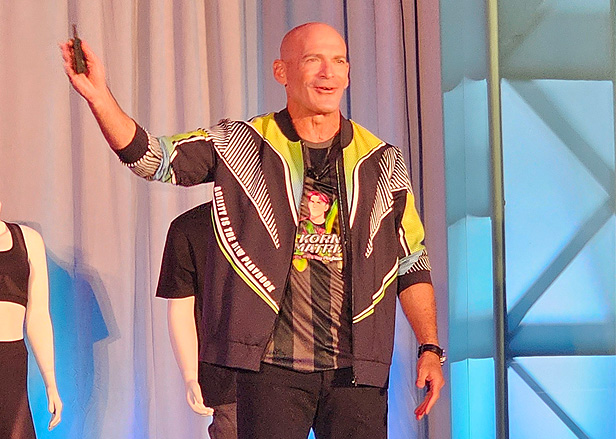
Ronen Samuel, Kornit Digital CEO, talks about the factors affecting the apparel market during Kornit Konnections.
“We are now living in really unpredictable volatility, and this volatility is going to stay with us,” said Ronen Samuel, CEO of Kornit Digital, during opening remarks at the conference, which the Israel-based manufacturer of direct-to-garment printers has hosted the last four years.
Unpredictability in the supply chain due to tariffs and other geopolitical factors, the rise of AI and the growth of the social media economy are among the factors affecting the apparel and promo products industries, he added. In this landscape, Samuel said, agility and print-on-demand production have moved from a “nice-to-have to a must-have.”
“The winners will be those who can say yes more often – yes to new ideas, yes to shorter runs, yes to faster fulfillment, yes to less inventory, yes to more creativity,” Samuel said. “Let’s move this industry to on-demand.”
Daymond John on Entrepreneurship
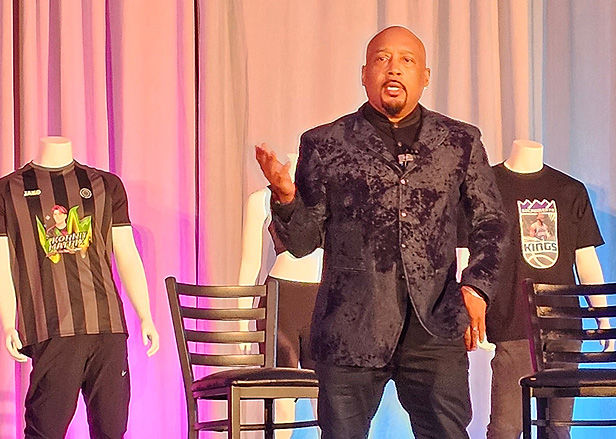
Shark Tank mainstay Daymond John delivers a keynote speech during Kornit Konnections.
Daymond John, founder and CEO of FUBU and an investor on ABC’s Shark Tank, shared how he got his start in the apparel industry as well as his thoughts about the future of the industry during a keynote address kicking off the conference.
Back in 1989, John recalled, on a chilly day in early spring, he was standing outside a mall, shivering, ready to sell hats his mother had taught him to sew. In just one hour, he sold $800 worth of hats. “I remember saying, ‘I’m never going to work for anybody ever again for the rest of my life,’” John said.
John talked about the challenges of growing his business, saying yes before knowing how you’ll deliver, as well as how e-commerce, on-demand production and AI are changing the landscape of retail. He also gave his definition of entrepreneurship: “Entrepreneurs are very clear on the overall goal they want to accomplish,” John said. “They’re always on the search for more information. … They wake up every day saying, ‘How can I be of more value to my customers today than I was yesterday?’”
‘The Watershed Moment’
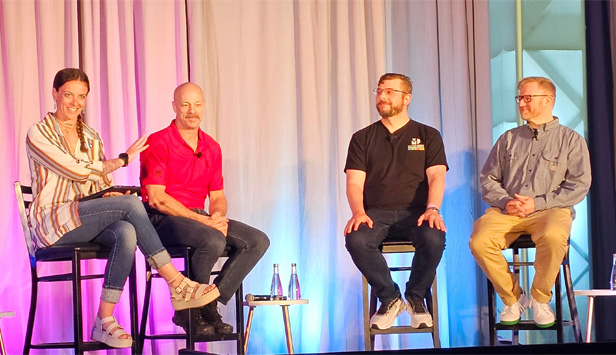
Cassie Green of Apparelist talks with (from left) Stacey Wharton of Nine Line Apparel (asi/283678), Jaymes Clements of Monster Digital, and Andy Espenel of Zumiez during a session at Kornit Konnections.
In a session called “The Watershed Moment,” moderator Cassie Green, content director of Apparelist, explored why digital decoration is a strategic advantage. “Digital is at the epicenter” of this watershed moment, she said. “It’s a point where quality is meeting price is meeting demand is meeting trust.”
Jaymes Clements, president and chief commercial officer of contract decorator Monster Digital, noted that slow supply chains and high inventory-carrying costs “are becoming unacceptable and unsustainable” in the marketplace.
“What we’re seeing is an adoption of [digital technology] where it’s the end-customer driving these decisions,” he added, noting that end-users want quick turns and endless selection.
Andy Espenel, vice president of business development at skate apparel brand Zumiez, talked about how the brand has tightened up its supply chain to allow for on-demand printing, putting out limited styles in stores, then “backing up the truck and loading them up with inventory,” when a particular style gets popular. “That flexibility has really helped us to limit markdowns and focus on driving sales,” he added. “Our customers are speaking to us. When we have what they want, they buy.”
Stacey Wharton, chief production officer at Nine Line Apparel (asi/283678), emphasized the importance of having detailed customer sales data and nimble production. The company, which has 11 retail stores along with a robust e-commerce site, uses digital technology to test designs, adding a new design to one store to see how well it does before adding it to the website or other locations, for example. “It’s very fluid,” Wharton added.
The Power of Automation
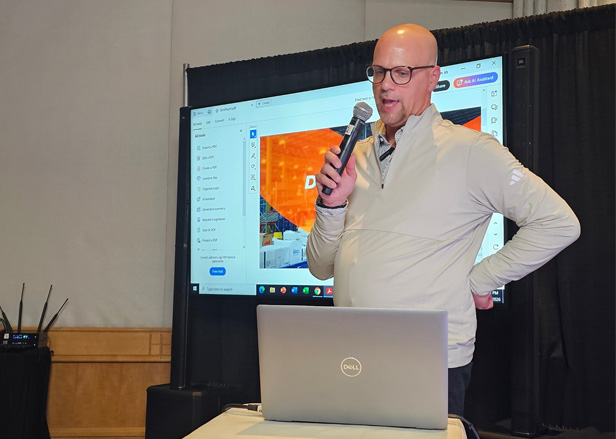
Jason Peters of S&S Activewear (asi/84358) discusses the supplier’s automated warehouses and “zero-touch technology” during a session at Kornit Konnections.
Also during the conference, Jason Peters, director of strategic accounts at S&S Activewear (asi/84358), gave a talk about the Counselor Top 40 supplier’s $200 million-plus investment in distribution automation technology.
Among the advancements S&S has introduced is “zero-touch technology.” Every box shipped out of the warehouse has QR codes that unlock an “automated packing slip” and customer service forms in case there’s an issue. “It’s a really big thing when trying to receive and stage,” Peters said.
The supplier also has five automated warehouses across the U.S., with a system that includes robotic technology for real-time inventory tracking and management and efficient handling of print-on-demand orders. “We have 99.9% accuracy,” Peters added.

Print & Promo Marketing is your source for news, commentary and strategy for the promotional products, commercial print and product decoration industries.