News CANADIAN NEWS April 20, 2026
Q1 Industry Sales Rise 1.8% as Inflation, Iran Conflict Weigh on Market
The results mark a sharp comedown from the industry’s strong 2025 second half, though distributors remain optimistic despite ongoing uncertainty.
Key Takeaways
• North American promo products distributors grew Q1 ’26 promo sales by 1.8% year over year, a notable drop from the second half of ’25.
• The war in Iran and economic uncertainty – which has driven up energy and shipping costs, disrupted supply chains and compounded tariff concerns – weighed heavily on industrywide confidence.
• Top-performing distributors credited vertical diversification, investment in people and AI, and strong client relationships as key factors in continued sales growth.
Soaring inflation, cost increases fueled by the war in Iran and continued tariff uncertainty have all contributed to a rocky start to the year for promo distributors. That’s according to data from the latest ASI Research Distributor Quarterly Sales Survey, which shows declining confidence across the industry and sales up just 1.8% year over year for North American promo products distributors in the first quarter of 2026.
“After a strong Q3 and Q4 in 2025, Q1 was a rollercoaster for promo distributors,” says Nate Kucsma, ASI’s senior executive director of research. “Positive movement on the tariff front was quickly offset by the war with Iran and rapidly rising energy prices. Optimism runs deep across this industry, but I think what many in promo need right now is more stability.”
1.8%
Q1 2026 promotional products industry sales growth when compared to the first quarter of 2025.
Owing to tariff uncertainty and a trade war the previous year, the first half of 2025 was challenging for the promo industry, with sales declining 3.6% and 3.2% year over year in Q1 and Q2, respectively. The second half of the year was much better, as promo sales rose 5% in Q3 and 5.1% in Q4.
However, that momentum did not carry into the first quarter of this year. Nearly 40% of distributors said the quarter went worse than expected, compared to 32% who said it was better than expected.
The industry’s 1.8% growth in Q1 is even more modest when considering the rise in inflation over the last few months. The Consumer Price Index increased by 3.3% in March, according to data from the Bureau of Labor Statistics, driven by the rising cost of energy and goods as a result of the war in Iran. This means that industry sales were relatively flat when measured against rising prices. Inflation also had a direct effect on distributors, with nearly three-fifths of firms saying that rising consumer prices had a negative impact on promo sales in Q1.
Larger distributors outperformed smaller ones, with distributors under $1 million in revenue experiencing sales decreases in the quarter. Distributors with between $1 million and $5 million in revenue had the best quarter among any size classification, with 4.7% growth.
The largest distributors in the industry – with over $5 million in annual revenue – who have historically grown the fastest experienced a relatively pedestrian quarter of 1.1% growth.
Counselor Top 40 distributor Geiger (asi/202900), for instance, saw strong sales and order activity in January before experiencing a slowdown in February and March.
“We got off to a really hot start this year … we had some pretty big orders come in,” says David Geiger, president of the firm and a member of Counselor’s Power 50 list of most influential people in promo. “I think where we started to see a little bit of a slowing was last month.”
In total, only 38% of distributors increased their sales this quarter, down slightly from Q1 2025 and a significant decline compared to the end of last year, when half of distributors reported sales growth.
External Forces
It isn’t lost on David Geiger that the firm’s sales began to slow right around the time when the conflict in the Middle East began. In February 2026, in a retaliatory measure for aggressions specific to the war in Iran, the Islamic Revolutionary Guard Corps issued warnings to vessels that prohibited ships from passing through the Strait of Hormuz, a key choke point in the global supply chain. The blockage thereby stopped all traffic and oil exports from Gulf States from passing through the waterway (the Strait of Hormuz is responsible for routing nearly 25% of the world’s oil supply).
As a result, gas prices have skyrocketed, with the average price of gas now hovering at $4.04 per gallon as of April 19. The rising cost of fuel has also had a significant promo impact, with everything from the price of plastic and polyester to freight and last-mile delivery growing more expensive.
Over the last few weeks, the Strait has reopened and closed several times as tensions in the region continue.
“I have concerns about the conflict and the costs of energy,” Geiger says. “I see that driving uncertainty and having an impact on buyer confidence.”
While Geiger reported quarterly sales growth year over year thanks to its strong January, it wasn’t as much of an increase as the firm had hoped for.
Counselor Top 40 distributor Overture Promotions (asi/288473) also saw revenue slow during the month of February when compared to January, but that is a pattern consistent with past years. “February is historically slower for us,” says Tej Shah, CEO of Overture and a member of Counselor’s Power 50 list. “Our theory is that buyers get excited at the start of the year, then pull back a bit.”
Promo suppliers, meanwhile, are beginning to see shipping delays and route changes because of the war, which most significantly impact suppliers in Europe and the U.K., but have also begun to indirectly affect U.S. suppliers, as well.
“Shipping routes will have to dramatically change, resulting in longer transit time, and a short supply of containers since vessels will get stuck in transit,” Eric Rubin, CEO of Counselor Top 40 supplier Blue Generation (asi/40653), told Counselor earlier this month.
“I have concerns about the conflict and the costs of energy. I see that driving uncertainty and having an impact on buyer confidence.” David Geiger, Geiger (asi/202900)
Dilip Bhavnani, chief operating officer at Counselor Top 40 supplier Sunscope (asi/90075), added that he’s witnessed warning signs of shipping challenges to come.
“The early indicators are already here: rising insurance premiums, fuel surcharges and inconsistent scheduling reliability,” he told Counselor. “What’s happening right now is less about immediate disruption and more about a systemic change of global shipping lanes.”
As negotiations between the U.S., Iran and an expanding group of involved countries continue, the future of the conflict – and its impact on the promo industry – remains unclear.
“It’s hard to bank on anything these days,” Geiger says. “Depending on what happens in the Middle East, it’s just so hard to predict. And now there are growing concerns that this conflict will move beyond the Middle East. Does this extend beyond the region and does this turn into something bigger?”
Even as St. Catharines, Ontario-based Brand Blvd (asi/145124) grew sales 30% in the quarter, co-founder and CEO Chris Sinclair acknowledges this quarter has come with some unique challenges. “You’ve got geopolitical uncertainty that shows no end in sight. Then, layer onto that a massive change of impossible-to-keep-up-with AI, and there’s a lot of uncertainty. It’s made people a little bit edgy,” he says. “And rightfully so. It makes [sales] a lot more difficult to forecast.”
Geiger and Sinclair aren’t alone in their concerns – and many firms are already seeing the effects. At the time the survey was fielded, 43% of recipients cited rising gas prices as having had a negative impact on Q1 sales, while 33% blamed the war in Iran for slowing or declining sales.
Tariffs, too, remain a concern, with 47% of respondents noting that the levies affected sales. In February, the Supreme Court ruled several of President Trump’s tariffs unconstitutional, though the administration responded by issuing a new (albeit temporary) 10% global tariff that will remain in effect for at least 150 days (late July). At that point, Congress will decide whether to extend those tariffs. If Congress doesn’t, many believe Trump will turn to other justifications to impose additional tariffs.
All this means that the future of tariffs isn’t entirely clear, and that uncertainty has permeated across the promo industry. Despite the landmark Supreme Court ruling, very few distributors believe the tariff situation has significantly improved since the beginning of 2025. More than 80% of distributors say the tariff situation has not improved over the last year.
Now, the conflict in Iran presents yet another economic hurdle for promo companies. In fact, more than half of distributors of all sizes believe some customers are delaying their orders until the economy improves.
55%
The percentage of distributors who agree that some customers are delaying their orders until the economy improves.(ASI Research)
Unsurprisingly, distributor confidence dipped in the quarter, according to The Counselor Confidence Index, dropping five points to 87. (The index measures distributor financial health and business optimism; 100 is the baseline.) Distributors are still expecting slight improvement as the year goes on, with a projected confidence reading of 93 for the end of 2026.
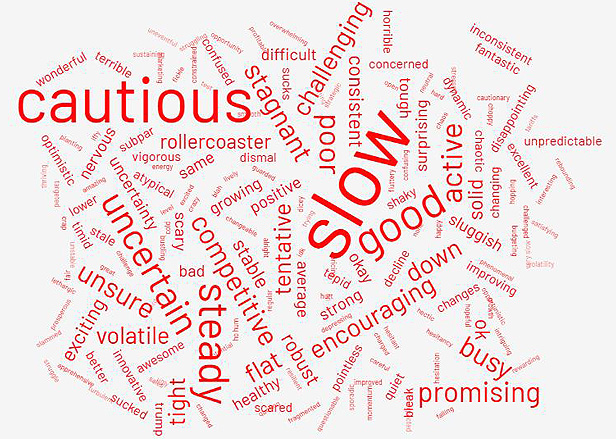
Meanwhile, when distributors were asked to describe the quarter in one word, many said “slow” and “cautious.” By comparison, respondents at the end of 2025 used words like “optimistic” and “hopeful” to describe their expectations for 2026.
Words used to describe Q1 ’26:
Remaining Positive
Despite the headwinds, many distributors remain optimistic, thriving in industries like healthcare and education – which distributors named the most robust for the quarter. Other verticals like associations, clubs and civic groups saw increased demand for promo.
Construction ranked as the third-most robust promo market in the quarter, with Shah of Overture and Sinclair each citing an uptick in requests from construction businesses.
Distributors are thriving in lucrative niches as well. Seth Kaminstein, president of SK Promotions (asi/525995), which does business across verticals including schools and large hotels, attributes a sizable portion of his company’s recent growth to partnering with party planners.
“A lot of my business is coming from Bar and Bat mitzvahs,” he says. “Part of the reason my business has picked up is because I work directly with party planners, and they bring a lot of business to me. I’m getting jobs in New York that are $15,000 each.”
Kaminstein relies solely on referrals and repeat customers. That means he treats every customer like they’re his only one – because a small job could easily lead to a larger one. “If you can build strong partnerships with customers and treat every customer like they’re your only customer,” he says, “chances are you’re going to get a referral.”
Still, even buyers in strong markets are being more judicious in their spending. One of Kaminstein’s customers, a university system with 22 campuses, didn’t purchase as much from him as they had in previous quarters. “They’re still buying a good amount, but their purchases have definitely come down,” he says.
David Geiger has witnessed a similar trend. “Education, institutions, schools, government … those are the areas we’re really seeing a softening,” he says. “These clients have been a little bit more strict on what they’ve budgeted and what they’re willing to spend.”
“It’s important to be diversified, because industry performance fluctuates all the time. You’ve got to be prepared if something happens in one industry and not the other.”Chris Faris, Boost Promotions (asi/142942)
While the practice of tracking demand across verticals is a useful one, Chris Faris, founder and CEO of Gloucester, MA-based distributor Boost Promotions (asi/142942), says distributors should continue to ensure their accounts are diversified across industries.
“I’ve seen the fall of a lot of companies, whether it was in the pharmaceutical industry, or the finance industry during a financial crisis,” says Faris, whose company saw an increase in sales and transactions in the quarter. “It’s important to be diversified, because industry performance fluctuates all the time. You’ve got to be prepared if something happens in one industry and not the other.”
Sinclair also believes in the power of diversifying accounts. “We’re pretty spread out, we’re not in [only] two or three specific verticals,” he says. “Thankfully so, because when some get hit hard, we can rely on others.”
Sinclair adds that despite these challenges, he’s bullish on the future of his company – and believes the promo industry will be able to weather all this uncertainty. “I’m optimistic … this industry is so resilient,” he notes.
Overture recorded a 20% increase in Q1, and Shah says the company is expected to increase sales by 10% for the year. The CEO strives to embed optimism in his work, even in the face of economic uncertainty. “We try to look past the noise that’s happening from a macro perspective and stay focused and disciplined on growth and how do we continue to make the right investments in sales and marketing, as well as operational investments to service our clients better,” he explains. “When we combine all that, we are optimistic about growth this year.”
The Distributor’s Guide to Success
What’s the secret sauce to maintaining growth amid economic and geopolitical uncertainty? Those who have found success this quarter attribute their sales to a few factors. Shah, for one, believes offering quality items and services goes a long way in growing business.
“At the end of the day, the most important thing is making sure you have a good product, making sure you’re easy to work with, and making sure you’re executing well,” he explains. “I think it’s underrated how important that is.”
He adds that investing in sales and marketing has also proven to be effective: “From an outbound standpoint, we’re making sure we’re telling the story we want and we’re attracting the customers that we want.”
Sinclair credits the company’s quarterly sales growth to an investment in people. He brought on talent from a marketing agency that expands the company’s capabilities to become a full-service, white-glove marketing agency.
The inspiration behind this shift was the growing trend toward ‘merch as media,’ a concept Sinclair has heard Michael Scott Cohen, a Counselor Power 50 member and the co-founder of Harper & Scott, talk about a lot. According to the “merch as media” movement, when merch is part of a company’s media spend, it’s more than just a giveaway at a trade show – it’s a core memory that can multiply a brand’s reach.
Sinclair also worked with a consultant to reimagine the structure of his sales team. Instead of the traditional model, where a sales representative operates independently and has a certain number of accounts, Brand Blvd has adopted a different approach known as “team selling.”
“With team selling, you have pods which include an account executive, two account managers, and a support role,” he explains. “Essentially it allows the account managers to focus on existing client relationships and allows the account executive to go out and get new clients.”
Sinclair adds that this new model has driven increased collaboration and a sense of group ownership. It’s also contributed to a better work-life balance, because “if someone is on vacation, the team picks up the slack,” he says. “And if a client wants answers right away, and a rep is on the road or traveling, they have three other people that can respond. The client response to this change has been great.”
Finally, Sinclair believes investing in AI has helped drive continued growth at the company. Last year, Brand Blvd hired two new VPs, including Bryan Caporicci, who heads up AI adoption and innovation at the firm.
“We're starting to now see the benefit of some amazing in-house tools and client-facing tools that he's built and is building,” Sinclair says. “A couple of these tools are being used for outbound client attraction by our sales and business development reps.”
“The most important thing is making sure you have a good product, making sure you’re easy to work with, and making sure you’re executing well. I think it’s underrated how important that is.” Tej Shah, Overture Promotions (asi/288473)
Faris, too, says an investment in AI and an experimentation mindset has contributed to Boost’s sales success.
“We operate like a startup to utilize different technologies, like AI,” he explains. “How do we communicate with clients in different ways? How do we engage new buyers? You have to try things and fail in different areas. It’s important to lean into new technology and get curious about it instead of being afraid of it.”
One thing that’s helped SK Promotions get ahead, especially when it comes to fulfilling quick-turnaround orders, says Kaminstein, is crowdsourcing and asking for recommendations from other distributors in the industry. He points to a specific scenario that happened a month ago where turning to his peers in the promo community proved especially beneficial.
“I had a customer asking for 1,000 shirts to be printed within the span of three days,” he explains. “I posted on one of the industry Facebook groups, and a printer responded to me directly and said they could do it. They did a phenomenal job and got the order to me the next day. If it wasn’t for this group, it would have taken me much longer to find a solution.”
David Geiger, for his part, says he believes the firm’s expansion into global markets has positioned it to continue its growth trajectory. Geiger has made a number of recent acquisitions in European markets including Germany, the U.K. and most recently Austria with the acquisition of Vienna-based distributorship Nowak Werbeartikel earlier this month.
“Where we’re doing fairly well, it’s selling the global part of our business,” David Geiger says. “Our clients really want boots on the ground in certain regions of the world. That seems to have given us some momentum, especially with our bigger clients that are expecting global solutions.”
How to sell during times of economic uncertainty:
- Take advantage of your promo network
- Invest in your product and your people
- Leverage AI to sell more effectively
- Diversify your portfolio across markets
- Don’t underestimate the power of referrals