Strategy June 29, 2026
As Drinking Habits Shift, Alcohol Brands Double Down on Meaningful Promo
Alcohol consumption among Americans is on the decline, but brands are still turning to experiential, retail-forward products to stand out in a saturated market.
Key Takeaways
• Despite declining alcohol consumption, beverage brands are prioritizing experiential marketing, retail activations and products that create lasting consumer connections.
• Distributors say alcohol marketers are increasingly building lifestyle-driven campaigns around concerts, festivals and pop-ups.
• Drink brands are investing in point-of-sale displays, value-added packaging and other retail-focused promotions designed to stand out.
Months after Hitex Marketing Group (asi/515762) created its viral “Bad Johnnie” cups – in collaboration with whiskey giant Johnnie Walker ahead of Bad Bunny’s concert residency in Puerto Rico – President and founder Enrique Perez got a call.
It was from a woman in Puerto Rico whose brother had just passed away. His two sons, she said, were fighting over their dad’s Bad Johnnie cup because it held onto some of their last memories with him, and she wanted to buy another.
Hitex sent two more cups their way (just to be safe), but for Perez, the call was more than just a heartwarming story. It encapsulates one of the biggest shifts reshaping alcohol and beverage promo products.
“It’s not that the promo spend went down or went up,” he says. “It’s that the promo has more meaning. That’s what clients want.”
Nearly every major news outlet has reported that Americans – especially young Americans – are drinking less these days. One analysis by Bloomberg found that the global value of top alcohol producers has dropped by $830 billion over the past four years, a 46% reduction from peak sales in June 2021. A Gallup poll last year reported that 54% of U.S. adults consume alcohol, the lowest reported level in nearly a century and as long as Gallup has been tracking the metric. And that percentage is even lower among the 18 to 34 demographic – which includes most of Gen Z and some millennials – at 50%.
As the market contracts, it doesn’t necessarily mean a dramatic drop in promo spend is taking place. Instead, many promo distributors say, alcohol and beverage brands are shifting their marketing priorities to focus on targeted promotions, experiences and events, and grabbing consumer interest on retail shelves.
“They realize that reducing your budget when the category is contracting is a recipe for disaster,” says Juan Fonseca, vice president of commercial enablement at MRL Group (asi/258137), which was recognized at the Shop! Outstanding Merchandising Achievement Awards this year for its work in the beverage, wine and liquor category.
“You don’t want to give consumers or current cultural trends another reason to continue accelerating a downward spiral in alcohol consumption,” he adds. “Smart suppliers are actually doubling down and still spending what they spent before.”
Prioritizing Moderation
The current crisis facing the beverage market is not necessarily that Americans are becoming more anti-alcohol overall, says Fonseca, who spent more than 25 years working in the alcohol and beverage sector before joining MRL.
Instead, what people seem to be increasingly opposed to is excess, on both the economic and health fronts. While many Americans are feeling the pinch of rising essential costs like gas and energy, multiple $20 cocktails at a restaurant may feel out of reach, or unnecessary altogether. There’s also a growing sense that consumers view even moderate alcohol consumption as worse for their health than in previous years, likely driven by the explosive health and wellness sector, especially on social media.
53%
of Americans report that drinking in moderation is bad for your health, a 14 percentage point increase since 2023 (Gallup)
Particularly in 2025, these factors – especially economic conditions due to tariffs – did result in lower promo spend for some alcohol brands. Jim Palmer, sales manager at HP2 Promotions (asi/217284), reports that his sales plummeted by around 70% last year after his main client, a large beer distributor, had billions of dollars in extra expenses thanks to extra tariffs on aluminum coming from Canada.
Projects are back so far in 2026, Palmer says, but decision-making is often slow, with his clients wanting more detailed quotes and extra confirmation from company higher-ups before giving the go-ahead on an order.
“They’re spending money now this year,” Palmer says. “But I can’t overstate how cautious people are.”
“Clients realize that reducing your marketing budget when the category is contracting is a recipe for disaster.”Juan Fonseca, The MRL Group (asi/258137)
But despite Americans toning down their drinking habits, there’s still an overwhelmingly strong desire for the experience of having a drink with friends, either at home or at a bar. The focus now, though, is on savoring the experience, rather than just the drink.
“Instead of having five glasses of wine, I’m going to have two,” is how Fonseca describes consumers’ drinking habits. “But I’m going to make those two glasses really good wine, and I’m not just going to enjoy the wine, but I’m going to enjoy the moment.”
And alcohol brands are taking note of the shift, especially when it comes to their marketing priorities.
“The category is evolving,” adds Lia Coonley, senior account executive at Blink Marketing (asi/141424), “instead of shrinking.”
Building a ‘Moment’
Promo pros tell Counselor that many alcohol companies are increasingly focused on having a presence in connection with events that align with their brands and their ideal customers. Take the Bad Johnnie cup as one example – Hitex engaged several exclusive bars across Puerto Rico to serve a signature whiskey cocktail in the cups during Bad Bunny’s residency.
Similarly, MRL Group worked with Kylie Jenner’s tequila brand 818 to create keychain charms ahead of the launch of the brand’s mini-shooter bottles. The charms were available to purchase for consumers in collaboration with Gopuff last fall, but the original brief was related to a pop-up experience at a music festival.
“It opens the door for a connection with the brand,” Fonseca says.
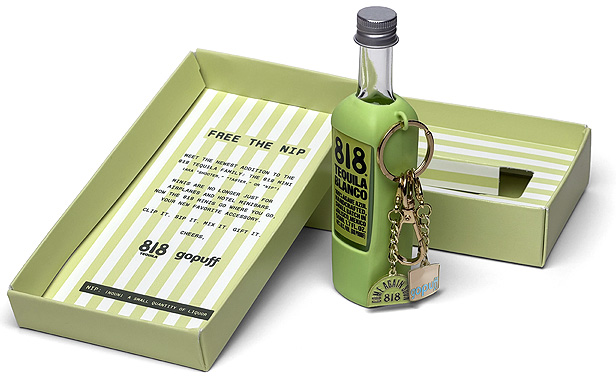
The MRL Group (asi/258137) worked with tequila brand 818 to produce these mini-shooter keychains and charms for a music festival.
In those instances, it’s all about brands being present for cultural moments. The World Cup has provided huge opportunity for alcohol brands to be exposed to hundreds of thousands of fans in cities across the U.S., and many of them have taken advantage, setting up pop-ups or significant branding at fan events and in retail. Hitex has extended its success with the Bad Bunny cup, for example, to a custom product shaped to look like the World Cup trophy.
Quality, relevant promo items provide an opportunity for brand connection to extend beyond the end of an event.
“That’s what our customers are trying to get to,” Perez adds. “They want to be remembered.”
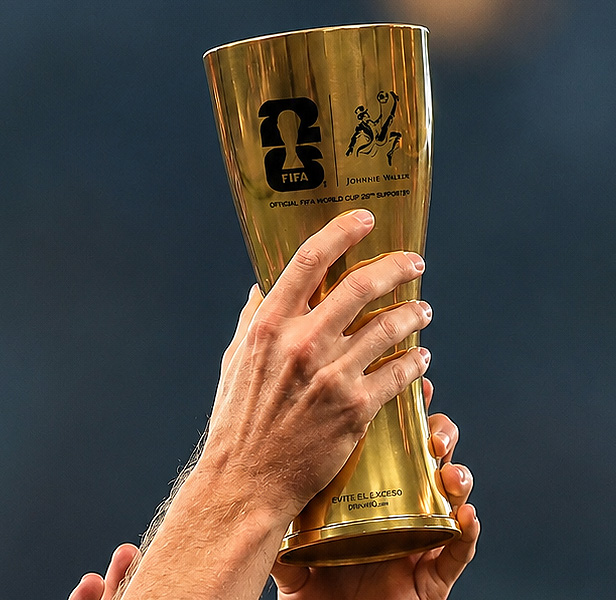
Hitex Marketing Group (asi/515762) has created custom drinkware shaped like the World Cup trophy that turn an event giveaway into “more than just a cup,” says President Enrique Perez.
The push for creating memories for potential consumers includes events and pop-ups hosted by the brands themselves, says Coonley. Blink Marketing’s clients include a variety of alcohol and beverage brands, especially seltzers, as well as a lot of projects in the college and university market.
She recently worked with ready-to-drink cocktail brand Mom Water on a “Bes-Teas”-themed event celebrating the launch of its new line of spiked teas.
The branding, and much of Mom Water’s social media coverage around the event, was meant to position the drink as an essential for a summer hangout – with the “bes-teas,” as it were – based on good vibes and connection. Not surprisingly, the promo that was handed out matched that “lifestyle” approach. In addition to custom decorations, displays and signage, Mom Water also gave out custom makeup bags and claw clips to attendees.
“The drink market is so saturated right now,” Coonley says. “You have to build a lifestyle or an image around your brand instead of just focusing on the drink itself at this point.”
Reaching Customers Where They Shop
As impactful as the event space can be, the trend toward declining alcohol consumption has also prompted many brands to double down on their in-store retail marketing, especially given today’s crowded marketplace. When it comes to beverages, consumers currently have plenty to pick from, in part thanks to the growing popularity of the ready-to-drink cocktail category over the past several years, including top canned seltzer brands like Surfside that market themselves to be “better for you” in the wellness era. And the number of nonalcoholic options available has grown as well: “better for you” prebiotic sodas like Poppi and OLIPOP, celebrity-endorsed nonalcoholic beer and wines, cannabis-infused beverages and even canned water brands like Liquid Death.
All of that is to say, consumers have options – and brands need to find a way to build a connection prior to purchase.
“In today’s world, that also happens in a pre-shop fashion through digital marketing,” Fonseca says. “But ultimately the digital shopper still goes into the brick and mortar to buy the bulk of their alcohol purchases.”
That’s the primary driver behind increased focus on the retail environment, Fonseca says.
And it’s not just about point-of-sale displays, though that’s a huge part of it. The same desire for building brand engagement that happens at events is fueling retail-focused spend as well. Fonseca has seen a variety of options built to use the in-store environment for a marketing advantage – shelf disrupters, display pieces, signage with interactive components or QR codes, just to name a few.
“The category is evolving, instead of shrinking.”Lia Coonley, Blink Marketing (asi/141424)
Perez, of Hitex, notes he’s seen significant business for alcohol brands offering value-added packs, or VAPs, in the retail space. He recently worked on a VAP for Casamigos ahead of the World Cup that included a bottle of tequila and four Casamigos and World Cup co-branded cups – the idea being that if people weren’t going to go out to the bar to watch the game, they had fun supplies to cheer on their favorite team at home.
The other win for VAPs, he says, is winning shelf space with the packaging and creating something to catch the consumer’s eye – and to add value, as the name suggests.
For Perez, the current challenges of the beverage sector are a prime chance for promo to prove itself as an effective marketing tool, both onsite at events and in the retail setting.
“I always think that’s a greater opportunity for us,” he says. “Whenever you have a problem to solve, then hopefully we use our products to be able to resolve those problems – and I think we’re doing that.”