
Strategy July 22, 2026
ASI Show Chicago 2026: Mastering Outbound Strategies
Kevin Baumgart of Sales Ink explains how distributors can plan and execute a measurable and effective customer acquisition program.
Key Takeaways
• Successful outbound sales start with clearly defining an ideal customer profile, researching prospects thoroughly and personalizing outreach to address their specific needs, said Kevin Baumgart of Sales Ink (asi/513151) at ASI Show Chicago 2026.
• Distributors can build a more consistent sales pipeline by assigning clear sales roles, tracking performance with KPIs and using a CRM to organize leads and automate follow-up.
• Baumgart encouraged promo professionals to evaluate and improve one part of their outbound sales process each week, emphasizing that consistent execution drives long-term growth.
Promotional products distributors need to be proactive about finding customers if they want to grow their businesses. More than that, they need to be strategic with their outreach, and they need to meticulously track their efforts to maximize efficiency and effectiveness.
This is what Kevin Baumgart does with his customers through his business, Sales Ink (asi/513151). In his presentation during Education Day at ASI Show Chicago 2026, “Consistent Pipeline, Zero Burnout: Create an Outbound Sales Process That Works,” Baumgart outlined four key areas that promo pros should focus on with their outbound strategies: leads, people, tech and campaigns.
Leads
When going fishing, you don’t just look at any old puddle and cast your line into it. You would do the research about what bodies of water are full of fish, what time of year they tend to hang out there and what they like to eat.
In business, Baumgart says that you need to identify your ideal client profile, and craft your approach to that specific person. With this, you should be getting as specific as possible. He uses an example of not just saying you want someone who works in healthcare, but someone who works at hospitals in the Chicago area with specific criteria. Now, from there, a distributor should go even deeper and find the people within that business that he or she would reach out to.
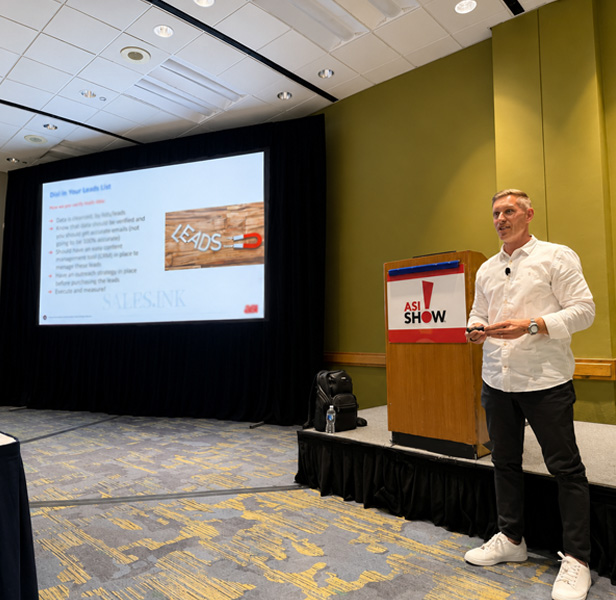
Kevin Baumgart of Sales Ink (asi/513151) explained how distributors can more effectively generate leads and acquire new business at ASI Show Chicago.
“We deal with a lot of different roles, a lot of different titles and a lot of different businesses,” Baumgart said. “So, to go outbound effectively, we have to dial in our ICP, but we also have to dial in our persona. This is the first step before we can now go get contact information.”
For that part, Baumgart said, a distributor can work smarter, rather than harder. Gone are the days of scouring physical phone directories. Instead, a distributor can pay for lead gen tools and acquire all of the data they need in moments.
People
Baumgart asks a simple question: Who does the work?
You have this great strategy, you’ve identified your ICP and have found their contact information, but now who does the legwork on the next steps in the process.
Baumgart has seen plenty of businesses where there is one person who does the identification of the ICP as well as all of the outreach and customer acquisition labor.
“In my experience, there are not a lot of salespeople who are good at and enjoy those jobs,” he said.
Think of it this way: The person who knows all of the local waterways and helps you identify the places to fish might not also be the person who enjoys crafting the bait and stringing it on the line.
Other industries, Baumgart said, have distinct sales roles within the organization: sales development reps, account executives and account managers.
“In a lot of businesses and industries, there are three distinct sales roles in each organization,” he said.
A business that has someone focused on these tasks as their entire job, Baumgart said, has a higher chance of success. Having someone who enjoys the work they’re doing will always pay dividends.
Now, a business owner must set KPI scorecards for outbound sellers and measure the effort and time they’re spending on a weekly basis, for example, to measure ROI.
Tech
For the measuring step in the process, Baumgart said that a CRM is critical. It allows you to organize all of the lead data and communication in one place to ensure things don’t slip through the cracks, and you can make sure everyone is held accountable and pushing in the same direction.
“A lot of times we find that salespeople live in their email and then live in their quoting software,” Baumgart said.
This can lead to disorganization, and the business owner might not be adequately tracking their progress. A CRM, Baumgart said, meets in the middle of the quoting software and email. It also allows you to manage automated processes like emails and other touchpoints on a set schedule, laying out a relationship timeline from the first LinkedIn connection to multiple calls and emails.
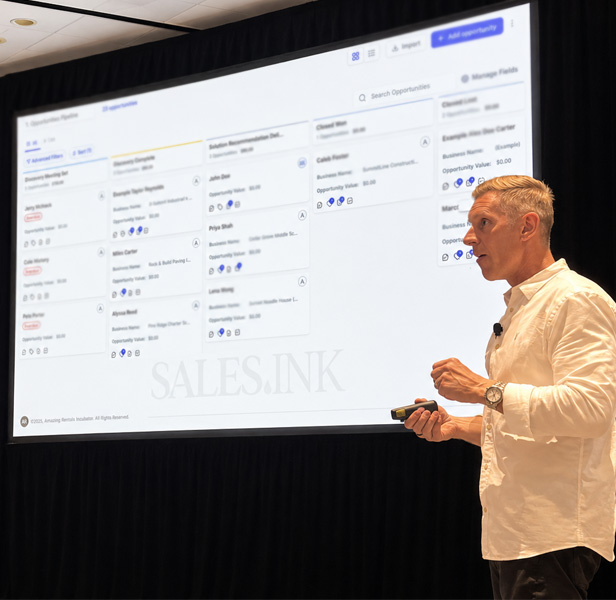
Baumgart demonstrated how a CRM can be helpful in staying organized throughout an outbounding strategy.
How many touchpoints are necessary, one audience member asked.
Baumgart responded that it often takes 10 or more touchpoints for a name to really sink in for a potential client.
And what about when the person who is now in charge of lead generation builds a relationship but then foists the customer onto the inside sales rep? Won’t working with a new person all of a sudden put the customer off a little?
“You can do it in a way that doesn’t push people away,” Baumgart said. “The way I typically structure it is a launch call.”
This is where the account executive might have the customer on a call with the account manager to introduce them, and explain that the account manager is more fitting for the next step in the process and benefiting the customer for their day-to-day needs.
Campaigns
This is where a salesperson needs to get personal and do their research. No customer wants to receive a robotic “Hello sir/madam” or “To whom it may concern.” It’s impersonal and it ends up in the trash immediately.
Baumgart shared a mantra that he goes back to in this step of the process: Show me you know me.
Personalization, he said, shows the potential customer that the salesperson is working for them.
Don’t send a generic sales pitch like “We provide high-quality promotional items to help your business stand out,” he said. Instead, appeal to their needs specifically and make it clear that you understand their business arena and can provide something that will make an impact.
He suggested something along the lines of “I’m hearing from heads of HR at tech companies in the Chicago area that they are really looking to dial up their new-hire kits and client gifts. Have you all thought about elevating this?”
Baumgart ended his presentation by giving attendees a bit of homework: Consider what parts of their outbound strategies they could work on this very week. What is the action that could improve? Who is in charge of executing it? When will it get done, and how will you measure whether it’s successful?
Through focused and measured outreach with adequate research and a dedicated staff that understands their roles, Baumgart believes that distributors can take their businesses to the next level regardless of what they’re selling.