
Printing May 08, 2026
Print Primer: How Embellishments Create an Experience
Special effects printing plays a key role in cutting through digital noise by creating a dimensional, tactile and interactive experience for recipients.
Key Takeaways
• Special effects printing – including foil, embossing, spot coatings and soft-touch finishes – helps printed materials stand out in a crowded digital landscape.
• Embellishments can drive measurable marketing results, with an example direct mail campaign achieving a 4% higher response rate when premium effects were added.
• Advances in digital embellishment technology are making premium finishes more accessible for shorter runs, personalization and customized campaigns.
There’s a saying in the printing industry that it’s a process of “ink on things.” But that really only tells one part of the story.
Today’s print is tactile, it’s dimensional, it’s interactive, and increasingly, it’s designed to stand out among the digital noise. That’s where special effects printing, often referred to as embellishments or enhancements, plays a key role.
For promotional products distributors, understanding these capabilities doesn’t mean becoming a printing industry expert. It’s about recognizing how special effects can elevate a piece and translate into a stronger brand impact for customers.
Standing Out in a Digital World
Embellishments refer to any process that enhances a printed piece beyond standard ink. These techniques are typically applied after the main print run and designed to add visual interest, texture or dimension. Effects can include things such as spot gloss, embossing and debossing, textures, and holographic visuals.
Since we live in a digital-first world, many marketing messages are lost in the onslaught of media. However, visual communications can slow recipients down and increase engagement time. Adding embellishments can further amplify the message by inviting touch or even added scent.
Packaging and printed materials with premium finishes are proven to influence perception and buying behavior, with many consumers associating these effects with higher quality and value.
In 2024, Printing Impressions, a publication of ASI’s strategic content partner PRINTING United Alliance, reported on a campaign launched by a car wash that found a 4% lift in response rate when embellishments were added. The business worked in conjunction with the Foil & Specialty Effects Association (FSEA) on the campaign that was sent to 7,500 residents within the surrounding area of a new car wash location. Of the 7,500, 50% were printed digitally with a four-color process, while the other 50% were printed the same way but with the addition of digitally applied embellishments. The embellishments included raised spot and textured coatings and raised digital metallic enhancements.
The campaign included an offer for the direct mail recipient to receive a free car wash and featured a barcode specific to the type of mailer to help the car wash determine which mailers were redeemed. For the print-only postcards, the response rate was 12.8%, while the embellished postcards had a response rate of 16.8%. Based on these findings, FSEA reported recommendations that “direct mail campaigns should include embellishments to improve response rates” and should “explore additional techniques and materials to further enhance the effectiveness of direct mail campaigns.”
This is just one example of how embellishments can impact engagement, but it illustrates how they can elicit a response from recipients and increase perceived value.
Embellishments aren’t limited to one category. They can be applied across a range of products and applications including packaging, direct mail, sales kits and collateral, and promotional products.
A good rule of thumb for embellishments is to start simple, applying the old adage “less is more.” Every effect doesn’t need to be used at once. In fact, the most effective designs often use one or two embellishments strategically. Overloading a piece can dilute the impact. Instead, focus on:
- What do you want the viewer to notice first?
- What feeling should the piece convey?
- Where will embellishment add meaning, not just decoration?
Key Terms To Know
Distributors don’t necessarily need to know how to achieve the most common embellishments, but it’s helpful to understand how they can be used. Here are some of the most common effects.

Velvet laminate, raised spot UV and purple foil were used on this brochure for a local food bank. (photo courtesy of Slate Group)
Foil: This technique adds a metallic or pigmented finish, often gold, silver or holographic, to specific areas of a design. It’s often used for logos, accents or key messaging, rather than across an entire piece. It’s especially effective when contrast is high, such as metallic foil on a dark background.
For distributors, foil is a go-to when clients want something that feels upscale without completely rethinking a design.
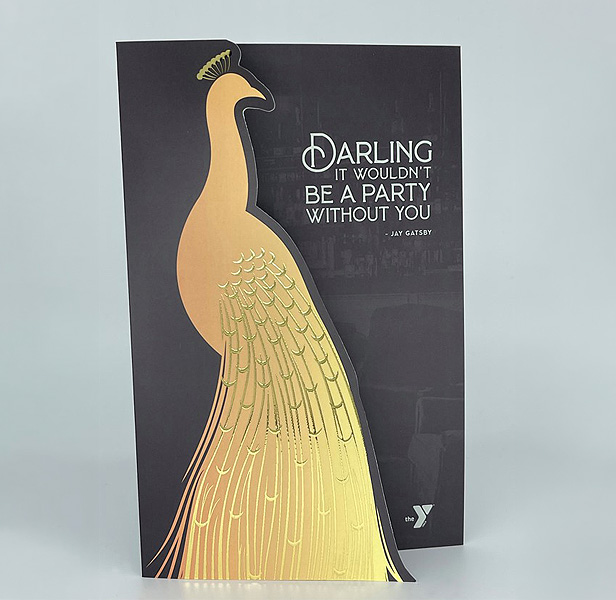
This piece from Rengel Printing was finished on a Duplo DDC-810 raised spot coater. It features spot coatings and gold foil to make the peacock’s feathers pop. (photo courtesy of Rengel Printing)
Spot Coatings: These are applied to select areas of a printed piece, usually over a matte background. It creates contrast and applies a subtle texture. Think of it as an “invisible highlighter.” It doesn’t change the color; instead, it changes how light interacts with the surface. It’s ideal for logos, headlines and patterns. Because it can also add some texture, it engages not only the eye, but also physical touch.
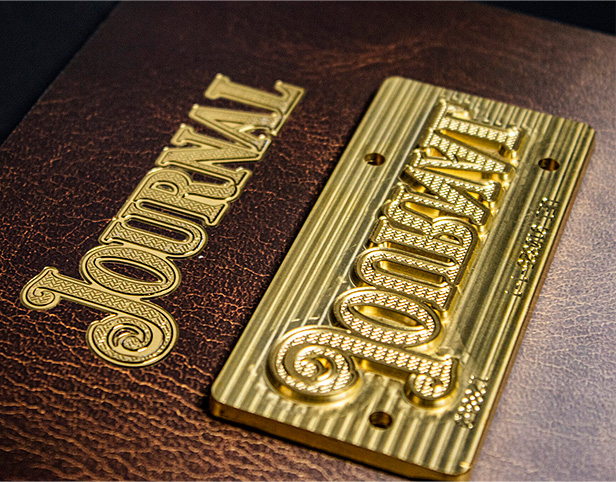
Embossing is another popular embellishment choice. (photo courtesy of Slate Group)
Embossing and debossing: Embossing raises an element above the surface, while debossing presses it in. It adds a tactile or 3-D feeling, creating depth without needing to rely on color. This is where embellishments become physical, inviting touch.
Soft touch and coatings: Soft touch coatings create a velvety, suede-like finish that feels distinctly different from standard paper.
In 2025, Printing Impressions spoke with Trey Laverty, director of sales development at Slate Group, who explained that embellishments need to fit the message of the printed piece.
“I just had a meeting with a hospice company, and we’re talking through velvet laminate and soft touch because it’s soothing,” Laverty said. “It’s calming to people going through tough times. Whatever the experience needs to be, good or bad, we can accomplish that.”
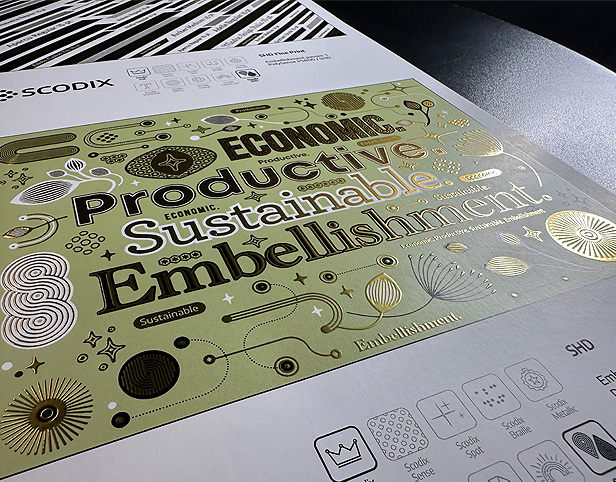
Hampden Press (asi/219057) used its Scodix Ultra 2500 SHD digital enhancement press to produce marketing support materials. (photo courtesy of Hampden Press)
Digital embellishments: Traditionally, many embellishments required custom tooling, which can be costly and time-consuming. Today, digital embellishment technologies are changing that.
These newer processes allow for variable effects (different embellishments on each piece), shorter runs and more complex designs, like 3-D textures or layered effects.
For distributors, this opens the door to customization and personalization, two trends that continue to grow in importance.
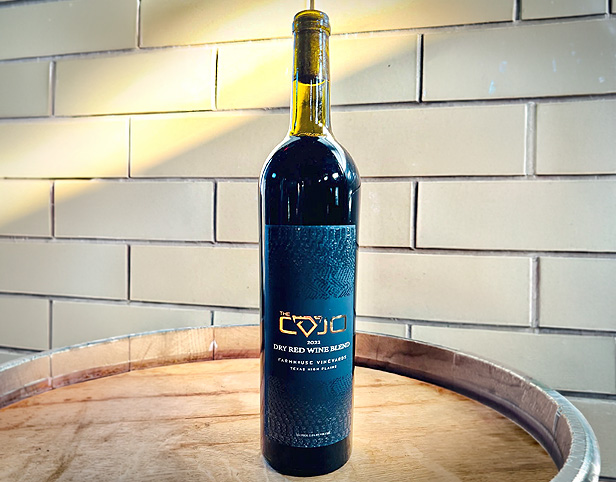
Embellishments are a popular choice for labels, especially when combined for further effect. Here, velvet laminate, raised spot UV and cold foil were used. (photo courtesy of Slate Group)
At the core, embellishments are more than aesthetics; they’re used to create an experience that engages multiple senses. They encourage people to slow down long enough for a message to land, ultimately helping customers stand out in a crowded marketplace. For distributors, this is a major opportunity. You’re not just offering print – you’re offering a way to make an impression that lasts.

Print & Promo Marketing is your source for news, commentary and strategy for the promotional products, commercial print and product decoration industries.