Strategy March 11, 2026
ASI Fort Worth 2026: Tap Into the Growing Uniform Market
At his Power Session, Caleb Churchill of Workwear Outfitters discusses how selling uniforms can help unlock new revenue streams.
Key Takeaways
• At his Power Session at ASI Show Fort Worth, Workwear Outfitters’ (asi/98258) Caleb Churchill offered some recommendations for how to sell uniform programs successfully.
• Modern buyers – especially millennials and Gen Z – expect uniforms to deliver comfort, style, durability and inclusivity, shifting the market away from stiff, traditional workwear.
• Selling successful uniform programs requires understanding the decision-making committee and offering solutions, including wear trials and tech-enabled tools that streamline sizing, ordering and ongoing program management.
Uniforms have been around since medieval times.
“People used to identify servants based on their uniforms,” said Caleb Churchill, director of national accounts at Counselor Top 40 supplier Workwear Outfitters (asi/98258).
Now, hundreds of years later, uniforms tell a story about identity. Just look at Target’s red polo and khakis combo, or the Starbucks green apron.
“When you create a uniform, you establish brand awareness, and that creates identity,” said Churchill.
During his Power Session at the 2026 ASI Show Fort Worth on Tuesday, March 10, titled “Selling Uniform Programs to Top Markets: Unlock a Repeatable Revenue Stream,” Churchill dove into the current uniform landscape and offered some recommendations for how distributors can unlock new opportunities in the space.
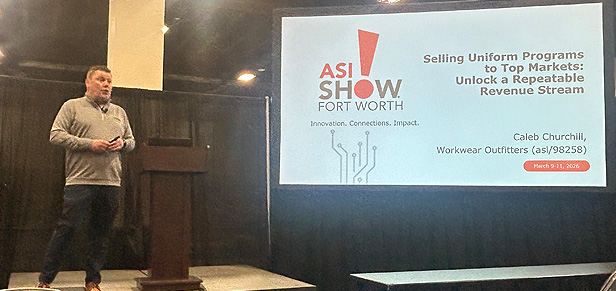
Caleb Churchill of Workwear Outfitters (asi/98258) offers tips on how to sell successful uniform programs.
A Ripe Opportunity
The uniform market is thriving. In fact, Churchill said more than one-fifth of employees wear uniforms.
However, when pitching workwear programs to end-buyers, Churchill said distributors need to “take off their blinders.”
“Don’t just think about the front of the house … consider the back of the house as well,” he said. “Think about uniforms for roles like maintenance or janitorial.”
Churchill also recommended looking for opportunities in top promo markets like healthcare, education and construction, where buyers are already investing in promo.
A New Generation of Uniform Buyers
When it comes to workwear, comfort is critical. “People want to be able to go out after work and not feel like they’ve been wearing uncomfortable clothes all day,” he noted.
Churchill remembers a time when the uniform he had to wear “felt so stiff it might as well have been a cardboard box.” But lately, a new generation has come in and changed the game.
Millennials are now the biggest share of the workforce, and Gen Z is following suit. These generations are influencing the market with evolving expectations, said Churchill, including comfort and fit, style and identity, functionality, durability, sustainability, tech integration, and inclusivity and sizing.
Finding the Uniform Program Decision-Maker
Most uniform programs are managed by a committee, which might include people in HR; marketing; operations; or health, safety and environmental management.
“This committee is not thinking about a product, but a solution,” Churchill said. “And by solution, I mean, how can you make their job easier?”
Once the committee is identified, Churchill recommended asking questions like:
- Who makes decisions on uniforms?
- Who is currently providing your uniforms?
- Is there a current contract?
- Can I offer your team a wear trial?
Technology, he added, has made this process even more efficient. “Uniform programs are easier than ever using tools that simplify everything,” he said. “Tech can help with things like sizing accuracy, so you don’t need to bring sizes all the way to the customer.”
A lot has changed since medieval times, but one thing has remained consistent: Uniforms tell a story. The right uniform program can help end-buyers increase brand recognition and employee satisfaction – all while helping to bring in more revenue for distributors.