
Printing June 08, 2026
How 35 Years in Print Led to Promo
Steve Enright of PromoPrint Group shares what he’s learned in his 35 years of print and promo and how his distributorship came to be in 2010.
Key Takeaways
• PromoPrint Group (asi/301688) built success by serving clients’ print and promo needs, with promo now often leading to additional print sales.
• For those new to print, owner Steve Enright suggests starting with simple products like postcards, flyers and brochures, and leaning on trusted print partners.
• Print can be a sticky revenue stream, with clients often remaining loyal once they find a provider that delivers quality and service.
Steve Enright spent 35 years in print – working summers in his sister’s retail print shop in Houston to building a career in commercial print sales – before jumping into promotional products.
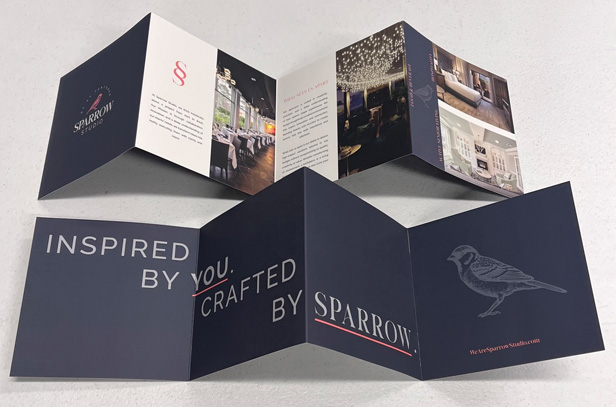
The best entry point for print is low-hanging fruit, like postcards, flyers, brochures, booklets and presentation/pocket folders. (photo courtesy of PromoPrint Group [asi/301688])
Along the way, he discovered promo through the same clients buying print materials. His first introduction came when his company needed to outsource wedding invitations and wedding accessory work.
“When we worked with clients on the marketing collateral like printed brochures, the same contacts were also purchasing promotional products, so these companies became members of ASI to have access to the supplier network and other resources,” Enright says. “It was a very natural way to offer these products since I was already working with the marketing team on print collateral.”
In the early 2000s, Enright began working for a distributor as an account executive, and in 2008, following the real estate and financial crisis, he lost over half his income, which made him reevaluate what he really wanted from his career. Ultimately, it was time to step out on his own, and PromoPrint Group (asi/301688) was born in 2010.
“My customers didn’t care what company I was working for and were supportive of starting my own company, so I began with those that were still active and began building new business,” he says.
Since then, he says buyers think about and view print differently.
“I believe that technology and online ordering for print is critical, especially for standardized items like business cards, postcards and flyers,” Enright says. “I also think that because of improved technology, clients are more receptive to ‘pleasing color,’ which makes grouping or gang run printers a good resource. Using features such as QR codes on printed media is a great way to connect with digital marketing.”
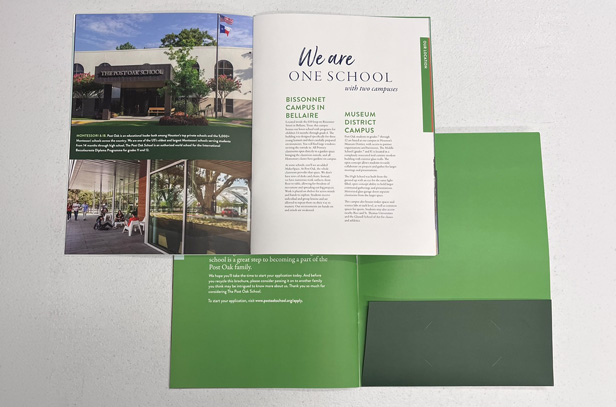
Allowing clients to browse products, sizes and features in an online store can help bring in sales. (photo courtesy of PromoPrint Group)
Speaking to how print and promo continue to work together, he says clients want one convenient source for both, and being a one-stop shop is a competitive advantage. “At this stage of my business, promo usually opens the door to print, although it used to be the reverse,” he notes. “This could be because my website mostly conveys promo, and prospects usually rely on that for niche information.”
For promotional products distributors curious about selling print, Enright says the best entry point is the low-hanging fruit: postcards, flyers, brochures, booklets and presentation/pocket folders. Taking it one step further, distributors who make it easier for buyers to browse products, sizes, features and even get a quote online can secure more orders.
Operationally, offering print does require some lift, but print partners are there to help distributors succeed. Enright suggests partnering with a local printer, which helps when issues arise and onsite visits or press checks are needed.
“Another critical element are resources for graphic design and art preparation,” he stresses. “If the client intends to handle their own graphic design, the distributor should have a list of guidelines for them to follow so that proper artwork files are created.”
Even with such guidelines, Enright adds, clients still send unusable artwork. It’s a problem that’s been growing worse with the advent of generative AI, with some people believing artwork created with ChatGPT is print-ready.
It’s also a necessary foundation to understand the basics in vector versus raster files, image resolution, spot-colors, RGB-to-CMYK conversion and bleed requirements to ensure print orders are produced professionally and correctly.
Don’t be afraid to turn away print business that’s not worth the effort, Enright says. For instance, business cards are a common ask, but they have so much data that can go wrong. Without an automated system to handle order processing, business cards take up too much administrative time to be profitable, he adds.
While 70% of Enright’s business comes from promotional products, one annual print project has remained his single largest order for 14 years. For distributors considering print, that speaks volumes about the possibilities in print as a revenue stream.
“I believe clients are less likely to change to another company for printing than they would be for promo,” Enright says. “Just as a distributor may be reluctant to add print, clients are less likely to shop around once a distributor performs well on quality and service on printed collateral.”

Print & Promo Marketing is your source for news, commentary and strategy for the promotional products, commercial print and product decoration industries.