
Sustainability June 17, 2026
Allmade Highlights Human Side of Apparel Industry With Annual Honduras Trip
The environmentally focused apparel supplier, which is partnered with Counselor Top 40 supplier SanMar, invited a group of distributors and decorators to see how its tees are made.
Key Takeaways
• Allmade (asi/34341) uses its annual Camp Allmade trip to give distributors and decorators a firsthand look at the apparel supply chain, emphasizing transparency, sustainability and the people behind garment production.
• Manufacturing partner Elcatex is investing in lower-impact textile production, including a dyeing process that uses 85% less salt, nearly 50% less water and 25% less energy than conventional methods.
• Camp Allmade combines factory tours with community impact, raising more than $30,000 this year for the Osovi boys home in Honduras while strengthening relationships across the promo industry.
A focus on the people – the hands who make the apparel we all wear – is at the core of Allmade (asi/34341). The environmentally conscious blank apparel supplier was launched a decade ago by a group of screen printers who wanted to change the world for the better.
“We’re not curing cancer; we’re just making T-shirts,” says Ryan Moor, CEO and co-founder of Allmade. “But guess what raises money to cure cancer? T-shirts.”
In the beginning, Allmade partnered with the Global Orphan Project to create a high-quality tri-blend tee and provide meaningful living-wage employment to workers in Haiti. As part of the launch process, Moor and other co-founders traveled to the country to visit the factory and meet the people making their T-shirts.
A lot has changed since the early days of Allmade, which formed an exclusive partnership with Counselor Top 40 supplier SanMar (asi/84863) in June 2020, but the focus on improving lives – and the impulse to be an eyewitness to the T-shirt making process – remains the same.
Each year, the supplier – along with representatives from SanMar – invite a group of clients to visit Honduras, where its tees are now made, for an experience they’ve dubbed “Camp Allmade.” Apparel decorators and promo distributors tour the factories, following the process from spinning to knitting, to dyeing and finishing, to cut and sew.
Following along the supply chain in person brings “a level of authenticity and transparency” that clients cherish, says Mel Lay, co-founder and marketing director. “I think it helps everyone appreciate the industry a little bit more,” she adds.
During the tours, Elcatex, the family-owned textile mill that creates Allmade and SanMar products, also outlines some of the sustainability measures it’s put in place to lessen the impact of apparel production. Rethink, part of Elcatex, holds four patents, including one for Sustendye, a line of reactive dyes for cellulose fibers.
“A T-shirt is not only a T-shirt,” Renato Guimaraes, CEO of Rethink, explained during a presentation at this year’s Camp Allmade. “There are a lot of things inside of that, and one of those is salt – the hidden enemy of the textile industry.”
Salt, along with other chemical discharge from typical fabric dyeing methods, can pollute waterways, killing freshwater flora and fauna, contaminating drinking water and causing other negative impacts.
Rethink’s Sustendye uses 85% less salt, nearly 50% less water during washing and reduces energy consumption by about 25%, according to Guimaraes. It also allows fabric scouring, dyeing and soaping to be carried out at low temperatures, decreasing fabric processing time by up to 25%. The Sustendye process involves encapsulating dyes and changing their charge to react more with the fibers, rather than the water, Guimaraes said.
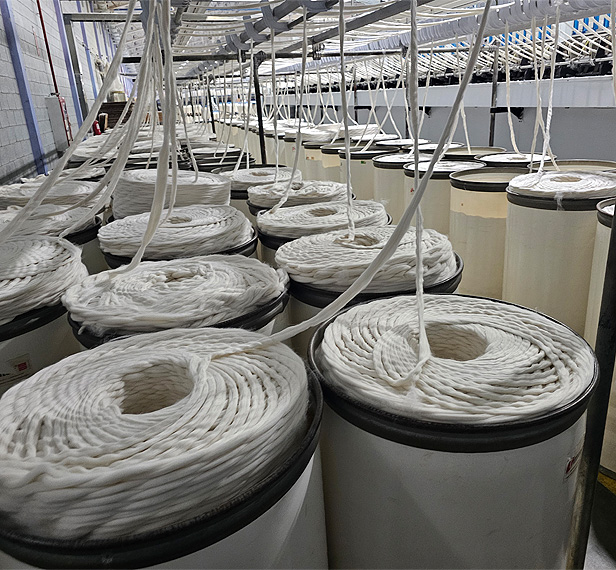
Cotton fibers are spun into yarn at a spinning facility in Honduras.
Elcatex also recycles and reclaims water whenever possible, updating its processes to be as efficient as possible. “We design everything considering the future of the industry,” Guimaraes said. “Elcatex used to have one textile facility and two wastewater treatment plants. Now, Elcatex has two textile facilities and only one wastewater treatment plant. We’re reducing the amount of water used per kilo of fabric.”
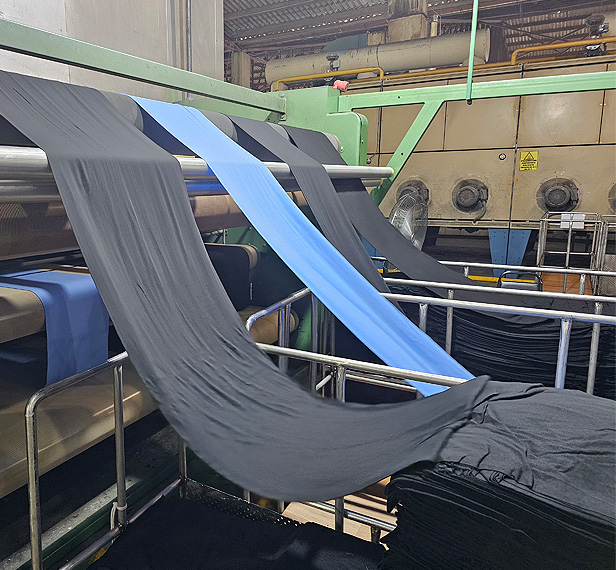
Dyed fabric is finished at the Cottonwise factory in Honduras.
Other sustainable practices by Elcatex include investments in renewable energy, including large-scale rooftop solar panel arrays on all facilities. Pre-consumer fabric upcycling is also a regular practice. “We take the scraps from the garments to make a new garment,” Guimaraes said. “That’s the most efficient way to do it because we can control the quality, color and consistency of the yarn.”
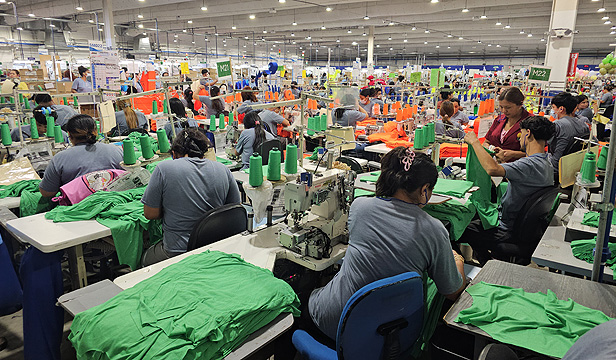
Allmade (asi/34341) T-shirts are assembled at the Suyapa cut-and-sew facility in Honduras.
The textile mill has been nominated as a North Star facility by Fashion for Good, a global innovation platform, to help align on best practices for the decarbonization of the textile industry, Guimaraes added.
“It’s not enough to watch change happen; you must lead it,” he said. “For decades, the textile industry has had a lot of impact and created massive waste, but we’re coming to prove that we can scale sustainable processes, that it’s profitable to use fewer chemicals.”
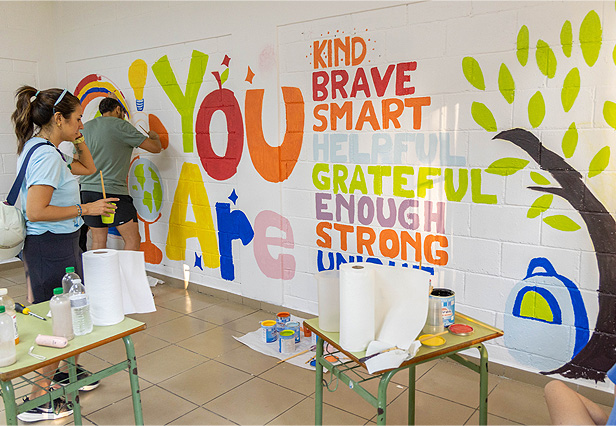
Attendees of Camp Allmade visited the Osovi boys home in Honduras, helping renovations, including painting a mural that had been drawn by one of the children there.
After touring the textile factories, Allmade took campers to a group home for boys run by the Osovi Foundation, to play soccer and share a meal with the children there, as well as to assist with renovations. Two years ago, Allmade raised more than $23,000 to help remodel the kitchen and bedrooms at the girls home run by Osovi. This year, the supplier was raising money to redo the roof, buy new appliances and update the basketball court at the boys home. Thanks to fundraising before, during and after this year’s visit, Allmade was able to send Osovi a donation of more than $30,000.
“It’s the little things we can do that make a very big impact on lives in the community that we’re making our apparel,” Lay said.
Camp Allmade ended with a daylong excursion to Finca Don Andres, a family-owned coffee farm in Santa Bárbara, Honduras. Campers had the opportunity to walk through the fields, learn about the roasting process and sample a variety of specialty coffees.
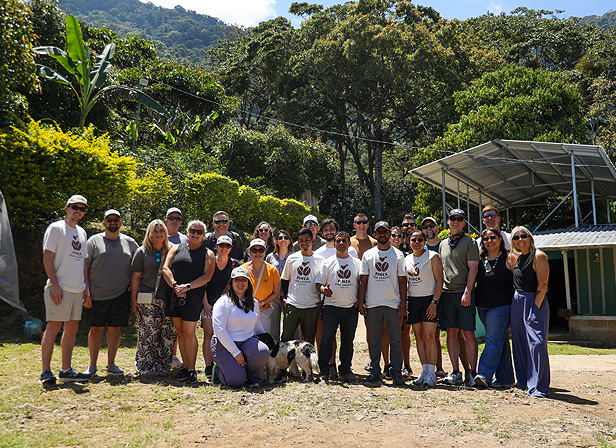
Camp Allmade attendees visited a family-owned coffee farm in Honduras.
For many of the distributors and decorators who attended Camp Allmade, it was a deeply meaningful experience, particularly the chance to interact with the children at the Osovi group home.
“While the trip included a deep dive into manufacturing, touring everything from yarn spinning to sewing facilities, the most impactful takeaway was the shift in perspective,” said Michael Freark, director of demand strategy at Counselor Top 40 distributor Custom Ink (asi/173232). “Spending the afternoon playing soccer and breaking bread with these kids was a necessary reality check. The resilience and positivity they carry is a stark contrast to our daily grind in the U.S., and it’s a powerful reminder to appreciate what we have.”
The trip was also a unique opportunity for attendees to make lasting connections with other campers.
“What started as a group of strangers and a few familiar faces quickly became something more,” said Rusty Pepper, head of global markets and partnerships at Taylor OnDemand, part of Counselor Top 40 distributor Taylor Promotional Products (asi/333647). “By the end of the trip, we weren’t just a group, we felt like a family.”

Promo for the Planet is your destination for the latest news, biggest trends and best ideas to help build a more sustainable and socially-responsible industry.