
Printing June 09, 2026
4 Best Practices To Avoid Nightmare Scenarios With Contract Decorators
Distributors and contract decorators must develop strong partnerships and hone their communications skills to succeed.
Key Takeaways
• Hightech Grafix (asi/60774) says poor artwork is the biggest source of production delays, making file quality and proper artwork preparation critical to successful decoration projects
• Decoration timelines don’t begin until artwork is approved, payment terms are set and garments arrive at the facility.
• Strong distributor-decorator partnerships are built on clear communication, structured processes and mutual trust – not simply choosing the lowest price.
Any distributor reading this has likely encountered challenges when working with a contract decorator. And any contract decorator has probably felt frustrated when working with a distributor.
Whether it’s not getting all the artwork details, providing confusing POs or falling behind on deadlines, contract decorators and distributors have felt their fair share of painful interactions.
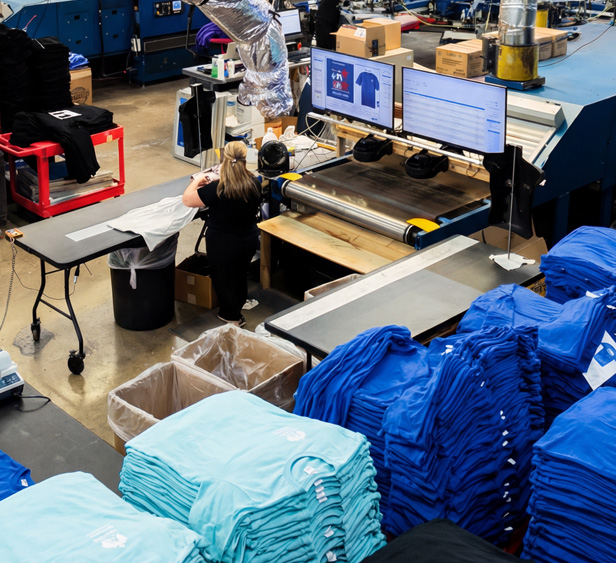
“Contract decoration, when it’s done right, is honestly one of the more underappreciated parts of this whole industry,” says Bryan Nichols, founder and president, Hightech Grafix (asi/60774).
But like any challenge, there are a handful of best practices that must be followed in each interaction to ensure a smooth process. Even though each order, product and scenario varies, the difference between a ruined relationship and a powerful partnership boils down to the basics. Here are four best practices to follow.
1. Understand Artwork
To really understand the best practices when working with a contract decorator, it’s best to go directly to the source. Bryan Nichols, founder and president of Hightech Grafix (asi/60774), has had a fair share of both positive and negative experiences. As a contract-only screen-printing, embroidery and direct-to-film partner, Nichols faces these scenarios every day.
What’s the single biggest challenge according to Nichols? “Artwork. Has been since I started this company back in 2008, and I really don’t think that’s changed at all even with everybody having design software on their phones now,” he says.
He sees this particularly when dealing with logos. Typically, a customer will pull a logo from their website for the distributor, who then hands it off to the contract decorator. The problem is that almost never works, since that method often means the image is only 72 dots per inch (DPI). For reference, the industry standard is 300 DPI in almost every scenario.
Nichols points out that when this happens, it leads to a lot of back-and-forth, which equals lost time. “We’re going back to [the distributor], they’re going back to their client and we’ve burned a couple days before anybody has even started talking about ink colors or stitch counts,” he says. “Honestly, 80% of the headaches that get blamed on production timing actually started two weeks earlier when a bad art file came in the door.”
He adds that the blame doesn’t necessarily fall on the distributor, though. “They’re not graphic designers,” he says. “They were never trained to look at a file and know if it’s going to image right at 12 inches wide on a hoodie,” he says. He simply encourages distributors to educate themselves to understand artwork better.
Bottom line? “Get the artwork right.”
2. Understand the Timeline
Nichols made an important point when talking about artwork that shouldn’t go unnoticed. Timelines are crucial. “Understand how the timeline actually works,” he emphasizes. “Decoration doesn’t start when you place the order; it starts when three things are true at the same time.”
Those three things are:
- The artwork is approved.
- Payment/terms are set.
- The garments are physically in the printing facility.
“If any one of those isn’t done, the clock isn’t running, no matter how many emails are flying around,” Nichols says. This also comes back to paying attention to details and making sure everything is in place right out of the gate. Any detail left out is time lost. He adds that panicked emails and phone calls shouldn’t happen if timelines and tasks are taken care of up front.
3. Communication Tools
Speaking of communication, Nichols recommends a few tools to help keep the process smooth, such as a login-secured portal. “From inside the portal, they can request a quote, submit an order, see their proofs, follow their job through every stage of production and they can also see real photos of their actual job once we’ve started decorating,” he explains.

Hightech Grafix uses a login-protected portal, which helps streamline communication with distributors, avoid errors and adhere to deadlines.
This helps streamline both external and internal communication. “As soon as the first piece comes off the press and passes QC, somebody takes a picture, and it gets uploaded right to that job record in the portal,” Nichols says. “If the distributor turned on notifications, they see it pretty much immediately. And if something looks off, they pick up the phone, we stop the run, we fix whatever needs fixing before we’ve ruined a whole box of blanks. That alone has saved more jobs than I can count.”
He also lists two other tools that play a role in communication, one being a structured purchase order. “Print method, colors, placements, sizing breakdown, quantities, due date, everything has to be filled in or the order doesn’t make it into the production schedule,” he says.
The second is quoting. “We run one-hour quotes through the portal during business hours, and we don’t quote over the phone anymore at all,” Nichols explains. “With everything in the portal, both sides can pull up the same record, and we don’t have to argue about who said what.”
4. Form Strong Partnerships
At the end of the day, things will go smoothly if both parties think of each other as partners. “Treat your decorator like an actual partner, not a vendor you call when you need to be saved on a rush,” Nichols advises.
He adds that the contract decorators that are willing to bend over backward for distributors do so because there’s a strong relationship in place. Get to know each other – ask questions, do some research, know where there’s wiggle room and understand the basics of printing.
Nichols notes that when there’s no effort to build a relationship, that’s where the real damage is done. “There are … distributors I won’t quote anymore because the relationship was strictly transactional, and they made every interaction harder than it needed to be,” he says, adding that he has peers who operate the same way.
Ultimately, it’s about transparency when it comes to successful distributor/contract decorator partners. When something goes wrong, pick up the phone. Don’t be afraid to have an honest conversation. “[Be] willing to actually tell each other the truth,” Nichols says. “If a distributor’s end-client thought the print felt thin or the box looked beat up, I want to know that.”
“The relationships that actually grow over the years are the ones where both sides are putting something into it beyond just place an order, ship it out, do it again,” he continues. “Decoration is a service. It looks like a product on a quote sheet, but it really isn’t. … Distributors who get this, the ones who pick their decorator based on the quality of all those little decisions instead of the lowest number on the quote, those are the ones whose end-clients reorder.”
Don’t Forget the Packaging

Packaging is just as important a piece of the contract decorating process as printing on garments.
Hightech Grafix (asi/60774), for example, uses double-wall boxes with box liners inside. The boxes are professionally printed on all four sides, and the contract decorator includes a UV-coated thank-you card on top of the apparel so that the recipient doesn’t accidentally slice into the first shirt when opening the package with a box cutter, according to Bryan Nichols, founder and president.
“None of that is required,” he adds. “None of it is in the quote. But when an end-client opens the box and the apparel inside looks like it came from a company that cared, that reflects well on the distributor.”

Print & Promo Marketing is your source for news, commentary and strategy for the promotional products, commercial print and product decoration industries.