
Strategy July 22, 2026
ASI Show Chicago 2026: Set Your Business up for Future Success
Jamie Watson, COO of Certified Marketing Consultants, shared top strategies for increasing the long-term value of promo companies.
Key Takeaways
• Building a valuable promotional products business requires balancing profitability, transferability and predictability so the company can succeed independently of its owner.
• Focusing on profitable customers and maintaining disciplined financial practices can increase a company’s attractiveness to buyers.
It can be difficult to plan for the future when it feels far away. But, despite that, promotional products business owners need to think about the future of their business – especially when those owners are no longer in the picture.
That’s where Jamie Watson comes in. Watson, COO of Certified Marketing Consultants, deals specifically with helping business owners make their company as appealing as possible to potential buyers – whether they want to sell now or they’re just making sure the long-term strategy for their company is in place.
Watson describes a business’s value as a three-legged stool: profitability, transferability and predictability. Each leg is just as important as the others. Without all three working together, it doesn’t stand.
“When all three are strong, value flows naturally, your operation flows naturally, you have less headaches,” Watson said, “and when it comes to selling your company or enacting whatever transition strategy you have in place, you have way more options.”
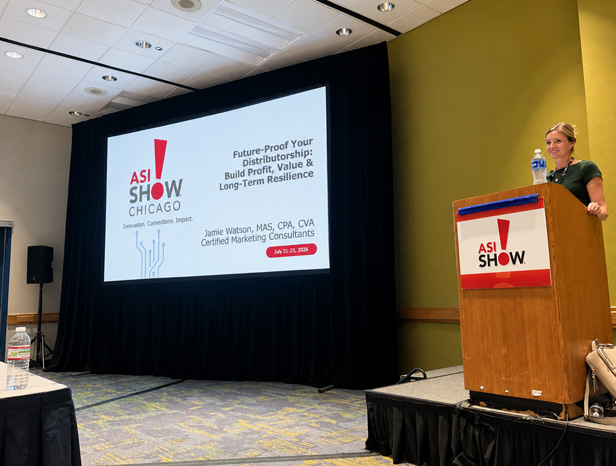
Jamie Watson, COO of Certified Marketing Consultants, gave a presentation titled “Future-Proof Your Distributorship: Build Profit, Value & Long-Term Resilience” at ASI Show Chicago.
In her presentation at ASI Show Chicago 2026, Watson discussed each of those pillars in detail and gave practical advice about how to make your business as valuable as possible now.
Profitability
This seems obvious – of course a business should be profitable. But, it’s more about maximizing profit and ensuring that you aren’t leaving potential money on the table somewhere. Watson said that industry average gross margin is somewhere around 35%, and that the “house minimum” is 17.5%.
“You can’t outsell bad margins,” she said. To combat this, a business must maintain price discipline and implement fair compensation for sales reps. Watson recommended a 40/60 split, or a sliding scale commensurate with margin.
“That can really incentivize and drive the behavior of the sales rep,” she said.
Watson also said that business owners need to sometimes face hard truths about their customers.
“Not every customer is a good customer,” she said. “Some aren’t profitable because they demand lower pricing. Some are just taking up too much of your time and resources, and your emotional resources along with that.”
Instead, Watson said that it’s good to focus on customers who value expertise rather than just price, and grow relationships that generate long-term profitability. And when you’re faced with even a long-time customer who doesn’t fit into this plan, it’s OK to cut ties.
“Not people-pleasing your way through a business can be a really important step to building a profitable business,” Watson said.
Profitable doesn’t simply mean sellable, however.
“I’ve seen incredibly profitable businesses that were also difficult to sell,” Watson said.
This could be due to transferability. A business owner must ask themselves: Can the business operate successfully without me in place? Would the ownership of the assets be easily transferred?
Look at your customer relationships – are they yours or are they the business’s? If you were no longer at the business, would those relationships disappear? A client list, Watson said, is the biggest asset of a distributorship.
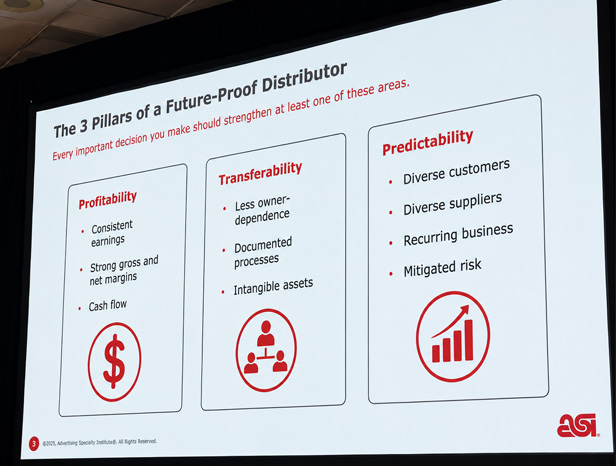
Watson said that a valuable business is built on three pillars: profitability, transferability and predictability.
Continuity
In addition to profitability, a buying party would want assurance that the business they’re buying will continue to be successful, if not more successful.
“Most buyers want confidence that what they’re purchasing is what they’re getting,” Watson said. “They want confidence that there’s going to be a return on investment.”
Looking at historical performance and how that impacts future results can indicate whether your business is one that a potential buyer would feel comfortable purchasing.
A consistent revenue base gives buyers confidence that revenue is sustainable. Stable margins mean good cash flow from loyal customers. A diversified customer base means lower risk of a major customer disappearing and taking all the profit with them.
Watson shared an anecdote about one client with 90% of its business tied to one brick-and-mortar retailer. She couldn’t sell the business because potential new owners weren’t assured the customer would stick around after the company was sold. It’s not uncommon, Watson said, for a company to start with a large share of its profit tied to a small collection of clients, but it’s important to grow, which is why she said it’s important to have a strong customer acquisition strategy.
Clean Financials
“No one would put their house on the market with clothes everywhere and a dirty kitchen,” Watson said. Likewise, a serious company wouldn’t put itself in the position to sell if its financials weren’t in immaculate order. These are the kinds of things that a business owner can and should do now, she said, whether or not a sale is in the short- or even long-term plans.
“Obviously, no one has a crystal ball,” she said, “but we’re talking about doing all of the things you can do to mitigate risk as much as possible.”