Commentary August 31, 2026
Everything Is Customer Service: Effective Communication Is About What’s Understood, Not Said
The best communication methods focus on conveying one simple idea and serving recipients – not the sender.
Key Takeaways
• Match the communication method to the recipient’s needs.
• Keep workplace messages with co-workers, customers and vendors focused on one idea.
• Follow verbal agreements with a confirming email.
I used to work with a vendor whose automated order confirmations included one line about my order and three whole paragraphs (with 🎉 copious 😀 emojis! 👍) telling me about all the other services they had to offer. If your inbox is anything like mine, you’ve trained your finger to hit DELETE the moment your eye registers SPAM. That’s exactly what I did. Except this time, the confirmation had a quiet little note – “Your order is on hold” – tucked in with all the colorful marketing, and I didn’t notice it. The consequence was a missed deadline and me losing a customer. Ouch.
It was my fault. But it was also their fault. They failed rule number-one of effective communication:
“It doesn’t matter what you say; it matters what was understood.”
You might be eloquent, even poetic. But if your factually accurate, masterfully written message is misunderstood, you still haven’t communicated effectively.

David Anderson, MASI, is president of Imprint Revolution (asi/541421), a distributor and decorator he has led for nearly 20 years. He has been working directly with customers since he was a teenager and hasn’t stopped since. A Cornell graduate and former Accenture consultant, he coaches business leaders on embedding exceptional customer service into the DNA of their organizations. He lives in Bend, OR. Contact him at david@davidanderson.consulting.
Here’s the Everything Is Customer Service rule of thumb: The best communication method is the one that serves the recipient, not the sender.
Because communication is customer service: It helps us understand the customer’s problem, solve it and make sure the customer feels heard and informed throughout the process.
Effective communication can be broken down into four elements:
● Focus
● Vibe
● Timing
● Mode
The first three usually suggest the best choice for the fourth, the mode – the method or platform in which you communicate.
Focus is about the message. Most written communication in the workplace can only hope to communicate one idea clearly. The confirmation email I mentioned earlier failed me because it tried to do too many things: confirm my order, warn me it was on hold and advertise to me. The advertising won out because the sheer volume of it (along with those wonderful emojis) redirected my focus. Worse, the “order confirmation” part of the communication contradicted the message I actually needed to hear: Your order is on hold; you need to act.
Next time you write an email, ask yourself, if they only take away one simple idea from this message, what should it be? Anything you write that doesn’t contribute to it takes away from it. Less is more, and more is nothing (TL;DR).
Vibe is the emotional content. Lots of work messages have near-zero emotional stakes. For example, an order confirmation. A little gratitude can lubricate the message, but if the main message is “thank you,” that’s the email. If the main message is “we have your order,” then that’s the message.
Some messages carry strong weight and need nuance and subtlety: Your order is on hold, we’re not going to make the deadline, we are unwilling to offer the redo you requested. These messages beg for tone of voice and will most likely work best in a mode that allows for back-and-forth, because the emotional vibe might need to change quickly during the conversation.
Next is timing. Not the timing of when we initiate the message, but when the customer digests it. If timing is critical, sending a first-class letter is probably ill-advised. But then again, so is email. Your customer might check it immediately, next month or never (especially if it silently slides into spam). Does the message need to be heard immediately? Do you need a response by a certain time? These answers lead you to choose the right mode.
We have an embarrassment of riches when it comes to communication modes. We can call, text, email or send a DM. Lest we forget, we can also travel (across the office or across town) to speak in person, and we can write a handwritten note. And of course there’s always the singing telegram.
With all these modes to choose from, it’s tempting to fall into this trap: using the mode that’s most convenient for you, the sender. But misunderstandings can be very inconvenient – and expensive.
In my company, we use this chart to choose the right mode for internal communication.
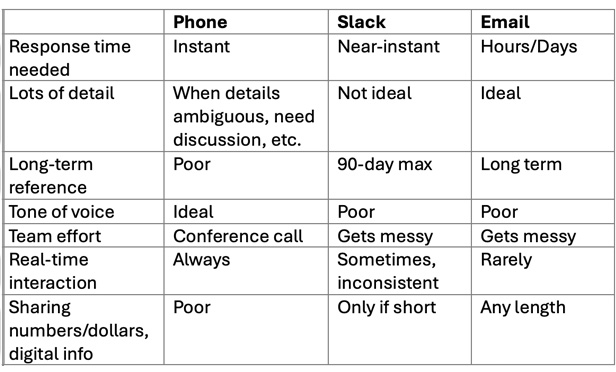
So which mode should you use? Let focus, vibe and timing decide.
● Call when tone matters, the issue is complicated, bad news is involved or you need an answer right now.
● Email when detail, attachments, documentation or future reference matter more than immediacy.
● Text/DM when the message is short, simple and time-sensitive.
● Handwrite it when the emotional impact matters more than speed. This is the sincerest way to communicate gratitude.
● Automate only when automation makes the recipient’s experience clearer or easier – not just making your process more efficient.
● Singing Telegrams: Just … no.
The right mode gives the recipient the best chance of understanding the message when and how they need it – even if it takes you out of your flow or comfort zone.
One of the most valuable mode choices you can make is this: Use two. If you need written documentation and an immediate response, send an email, followed by a text: “Just sent you an urgent email about your order. Please take a look.”
“It doesn’t matter what you say, or how you say it. What matters is what’s actually understood.”
Pro tip: If your customer ever decides or confirms anything verbally while you’re on the phone, always immediately send a follow-up email that says “Per our conversation just now, XYZ.” This does two things:
1. Checks for understanding. Maybe the light blue garment she approved was only for the youth sizes, and not the adult sizes. Your email will help her catch the misunderstanding before the order goes to press.
2. Covers you in a dispute. If she agrees to a new due date by phone and later claims she didn’t (perhaps she misremembers the conversation), you can point to your verifying email. This sounds like just CYA, but in addition to saving your company money, I find it actually builds trust. It says, “We’re organized and clear, and we document our actions.”
Mutual understanding is most likely to happen if the right mode is used. Focus, vibe and timing help us choose the right one.
In the end, it doesn’t matter what you say, or how you say it. What matters is what’s actually understood. And that’s good customer service.