
Printing April 16, 2026
Sustainability in Print: What’s Driving Progress
Regulation, consumer demand and innovation are pushing printers toward more credible, scalable, eco-friendly practices – despite ongoing challenges.
Key Takeaways
• Sustainability is no longer optional in printing, driven by tightening regulations, brand expectations and consumer demand for transparency and eco-friendly materials.
• Major challenges remain, including scalability, higher costs and the complexity of aligning materials, processes and end-of-life solutions across the supply chain.
• Progress is underway, with more fiber-based alternatives, improved certifications and practical steps (like waste reduction and certified sourcing) helping companies move toward sustainable operations.
Sustainability in print isn’t a trend. Maybe several years ago it was viewed as nice to have, or lacking any real backing, but between growing regulation and consumer awareness, sustainable practices in the printing industry are facing pressure to become permanent. The wide swath of materials and accessories that printing uses makes it a challenge to pinpoint next steps; however, strides are still happening.
Current Pain Points
Whether decorating apparel, embellishing signage or printing thousands of books for Amazon, printers are facing pressure to adopt sustainable practices. These drivers come from a variety of places.
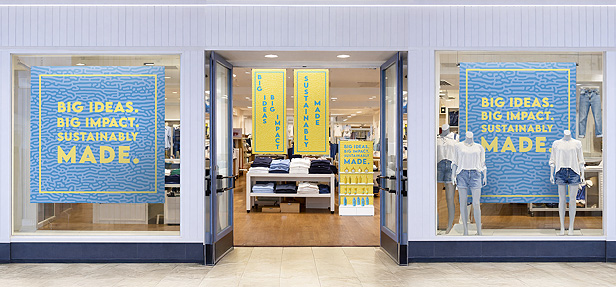
There is now a broader range of fiber-based blank substrates replacing plastics across signage, gift cards, tags and wide-format printing. (photo courtesy of Monadnock Paper Mills)
“The increased focus on sustainability in the printing industry is not a single-driver trend – it’s the convergence of regulatory pressure, brand expectations, economics and technology evolution,” says Julie Brannen, director, sales and sustainable solutions, at Monadnock Paper Mills. She cites the following specific key drivers:
- Extended producer responsibility (EPR) laws shifting end-of-life responsibility to brands
- Restrictions on single-use plastics and nonrecyclables
- Carbon reporting mandates (Scope 1-3 emissions)
- The push away from PVC, styrene and other petroleum-based substrates
- Increased demand for recyclable, compostable or fiber-based alternatives
- Documentation requirements and third-party auditing of claims and processes (LCA, certifications)
Marissa Garcia, director of responsible business at Counselor Top 40 supplier Next Level Apparel (asi/73867), emphasizes that the increasing legislation globally is one of the top reasons sustainability is coming to the forefront in the printing industry. “There are some very strict new laws in the EU about sustainable textiles and also about textile recycling,” she says. Those laws are now carrying over into the U.S. (California passed its EPR legislation in 2024).
Garcia also notes that consumers are paying attention and purchasing from brands that align with their personal sustainability beliefs. Between increased customer demands and more regulation, companies started implementing sustainable practices. But with that came a fresh set of challenges for those in the printing industry.

Scaling the production of sustainable apparel has been a challenge point; however, there’s been positive progress in the overall availability. (Photo courtesy of Cassie Green/Next Level Apparel, asi/73867)
Garcia notes that initially, many companies made sustainability claims that, upon further review, weren’t all that accurate. “There’s a lot of what is called ‘green hushing’ right now where companies are, in some cases, walking back their net-zero claims, or they’re just not talking about their certifications,” she says. Greenwashing and green hushing have landed many retail-facing companies, such as Nike, in the hot seat.
But that isn’t the only challenge printers are facing when it comes to sustainability.
“Sustainability in printing is not solved at the substrate, ink or coatings level alone – it requires system-wide alignment across materials, chemistry, processing and end-of-life infrastructure,” explains Brannen. And implementing system-wide changes on such a large scale isn’t easy or quick.
In fact, Garcia points to scalability as one major sticking point. She notes that scaling production of sustainable garments that meet specific regulations is difficult and takes time, but on a larger level, it comes with a cost. “If something is not at scale, that’s more expensive,” she says.
A big theme that ties everything together? The availability of resources – not every business has access to things like recycling programs, composting services and even sustainable blanks and accessories.
Positive Progress
Despite there being friction points, both sources note that real progress is being made in the printing industry. “A broader range of fiber-based blank substrates are now replacing plastics across signage, gift cards, tags and wide-format,” says Brannen. “Enhanced coatings and innovative substrate treatments (customized chemistries) are delivering better durability, moisture resistance and print quality in fiber-based substrates.”
She also points to progress being made in traditionally confusing topics like certifications and cost gaps. “Standardization of FSC, EcoVadis, ISO and TÜV Austria is improving credibility and reporting,” Brannen says. “Increased scale and competition are reducing premiums, [and] cost parity is emerging in many applications.”
And though there’s still a long way to go, Garcia says the combination of legal requirements coupled with customer demand is driving real change. Those are two major strategy points where printers should focus.
“Prepping for inevitable legal requirements around textile sustainability is something that you should really be preparing for as an investment,” she says. “When we’re talking about the financial aspects of it, if you are able to get ahead of [the legal requirements] – even if you’re not required to do it right now or even in a couple years – it is inevitably coming.”
That doesn’t just apply to textiles and garment decoration, either. Across the printing industry, legislation regulating things like inks, banned chemicals and recycling is growing. Brannen says that those who prep now will experience success down the road.
“The goal is to start with what is actionable today, not to solve everything at once,” she says. “For printers and paper suppliers new to sustainability, the most effective starting point is to focus on practical, scalable actions – beginning with certified sourcing, material simplification and waste reduction – while leveraging established industry frameworks and organizations that provide strategic guidance.”
Simple First Steps Toward Sustainability
Julie Brannen, director of sales and sustainable solutions at Monadnock Paper Mills, shares five steps print and promo professionals can take to build a more sustainable operation.
Step 1: Establish a Credible Foundation
- Source certified materials:
- Forest Stewardship Council
- Programme for the Endorsement of Forest Certification
- Attain Sustainable Green Printing Partnership certification.
- Secure an annual evaluation and scorecard rating from EcoVadis.
- Obtain ISO 14001 certification.
- Align with recognized standards to ensure immediate credibility with customers.
Step 2: Simplify Materials & Design
- Design thoughtful, customized materials that provide solutions and serve as alternatives to historical plastics.
- Prioritize fiber-based solutions instead of synthetics.
- Design for recyclability and/or compostability from the onset.
Step 3: Identify Quick Operational Wins
- Reduce waste through:
- Shorter runs and/or on-demand, digital print
- Improve forecasting and actively manage inventory control
- Track waste and energy usage to uncover cost-saving opportunities.
- Participate in closed-loop recycling programs with your paper mill where available.
Step 4: Optimize Inputs (Inks, Coatings, Adhesives)
- Transition to:
- Recyclable inks and foils where possible
- Recyclable-compatible coatings and adhesives
- Evaluate the full system impact – not just individual components.
Step 5: Start Scaling With the Right Applications
- Start with low-risk, high-impact use cases like indoor signage.
- Retail point of purchase
- Tags and short-term graphics
- Expand into more demanding applications as performance requirements are met.

Print & Promo Marketing is your source for news, commentary and strategy for the promotional products, commercial print and product decoration industries.