
Sustainability July 02, 2026
Q&A: Why Product-Level Impact Reporting Is Crucial
William Fairley, founder and commercial lead of Zilch, explains why the promotional products industry needs to embrace measurable sustainability solutions.
Key Takeaways
• Australia-based Zilch helps distributors answer growing customer questions about product-level sustainability by turning complex supply chain data into easy-to-understand impact reports.
• Product longevity matters as much as materials, with durable, reusable products often delivering lower long-term environmental impact than cheaper alternatives.
• Founder William Fairley says distributors can reduce product impact by prioritizing quality, recycled materials, less packaging and programs that keep products out of landfills.
William Fairley, founder and commercial lead of Australia-based Zilch, stumbled into the promo world by chance. He was chatting with a friend in the industry over a beer and explaining the concept behind Zilch: a service that can calculate product-level impact data to easily prove sustainability claims. Fairley’s friend mentioned that his solution seemed tailor-made for the intricate supply chain underpinning the promotional products industry. And the rest was history.

William Fairley, Zilch
In this Q&A, Fairley explains some of the biggest pain points the industry is facing when it comes to impact reporting, which product categories tend to have a higher overall environmental impact and some steps suppliers and distributors can take to lower their impact.
Q: What exactly is Zilch and how did the company get its start?
A: Zilch is a sustainability and responsible sourcing tool built specifically for the promotional products industry.
The idea came from a pretty simple problem: Product-based businesses sell physical products, and end-buyers increasingly wanted sustainability information about those products, but most of the available solutions were focused at the company level – certifications, sustainability badges, policies, company-wide footprinting or annual reports.
That matters, but it doesn’t really help a buyer when they’re choosing whether to put their logo on product A, B or C.
Nobody seemed to be approaching it at the product level, especially in industries with thousands of SKUs and messy supply chains. So that became the starting point for Zilch: helping promo companies turn product and supplier information into usable product impact reporting that helps them win business.
Q: Why is it important for promo to have an industry-specific solution to product-level impact reporting?
A: Promo is very unique: One order can involve a manufacturer, supplier, decorator, distributor and freight provider, with each holding a different piece of the puzzle. It’s also incredibly varied. A distributor might sell apparel, drinkware, bags, stationery, tech accessories and event merch, all with different materials, packaging and supply chains.
“[Company-level sustainability reporting] matters, but it doesn’t really help a buyer when they’re choosing whether to put their logo on product A, B or C.” William Fairley, Zilch
It has a unique commercial dynamic. Distributors are facing sustainability pressure from end-customers, but they usually don’t manufacture the products, so most of that information sits with suppliers and manufacturers.
That complexity and variability is exactly why nobody had really approached sustainability at the product level – and why promo needs a unique solution built for how the industry actually works.
Q: What are the biggest sustainability-related pain points the industry is facing?
A: Customers are asking questions distributors can’t always answer. For example, a buyer might say, “It’s bamboo, but why does that actually make it better?” or “How can you prove the product is recycled?”
Totally reasonable questions, but they’re not always easy to answer in promo because the information is fragmented across manufacturers and suppliers, and there’s no glue that ties it together in a usable format.
The second pain point is that companies don’t always know which path to take. Do they get an organizational certification? Do they measure and offset emissions? Do they create an eco-range? Do they focus on traceability? It’s hard to know where to start when the industry lacks a unified approach.
The third is simply time. Promo people tend to be busy folks. They’re dealing with quotes, deadlines, freight issues, artwork approvals, tenders, customer requests. Sustainability is important, but if the process is too manual, it just won’t scale.
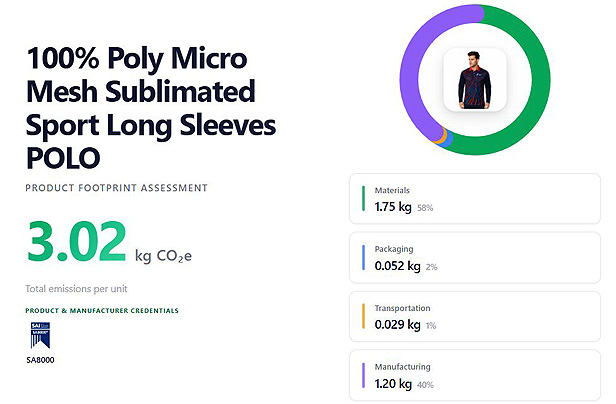
The top of a product report page created by Zilch
Q: Which products and categories tend to have the highest and lowest impact?
A: Electronics are a particular hotspot because of the complex manufacturing and energy needed to produce them. Don’t get me wrong, electronics can be great promo products if they’re actually helpful, good quality and get a lot of use. But cheap plasticky tech that’s going to break quickly and get tossed? Give that a miss.
The results can also be a bit surprising. Plastic products can sometimes look fairly low impact per unit because they’re lightweight. Take a plastic bottle, for example – it’s light, and you can make a lot of plastic from oil … go figure.
On the other hand, a virgin stainless-steel bottle will usually look like it has a much higher impact up front. But it’s also more durable, more likely to be used for years and much easier to recycle. So, the better question isn’t always “What has the lowest footprint on day one?” It’s “What will actually get used and stay out of the bin?”
Q: What are some strategies for lowering a product’s impact?
A: The first suggestion is obvious: Optimize for use. The product needs to be good enough that someone actually wants to keep it. Then look at material substitution. Recycled materials can cut impact significantly, especially for things like aluminum, steel, polyester and paper. Renewable materials like kraft paper, wood-based materials or bamboo can also be useful, as long as it’s not just a token “eco” veneer.
And finally, don’t ignore the boring stuff. Reduce packaging, move away from unnecessary plastic packaging where possible, and think about simple recovery programs. For example, at the end of an event, have a box for lanyards, badge holders or reusable signage so it doesn’t all go straight to a landfill.

Promo for the Planet is your destination for the latest news, biggest trends and best ideas to help build a more sustainable and socially-responsible industry.