
Sustainability February 06, 2026
Q&A: Mel Lay of Allmade on the Importance of Showing Your Impact
The sustainable apparel supplier recently updated the impact calculator on its website.
Key Takeaways
• Allmade (asi/34341) updated its impact calculator to meet rising expectations around data quality, transparency and credibility in sustainability conversations.
• The enhanced tool helps distributors and decorators clearly quantify environmental savings, turning sustainability from a “nice to have” into a competitive sales differentiator.
• By making product-level impact visible, Allmade aims to empower better purchasing decisions and push the industry toward greater accountability and transparency.
Allmade (asi/34341), a blank apparel supplier with an exclusive partnership with Counselor Top 40 supplier SanMar (asi/84863), has been a leader in the sustainable promo space since it launched a decade ago.
Back in 2016, screen-printing supply company Ryonet and a group of 10 screen-printing companies launched the line, with the aim of creating a positive impact with every garment sold. Over the years, the supplier has continued its commitment to planet and people, and was among the first in the industry to launch an impact calculator to help distributors explain metrics such as how much water was saved by purchasing one of the brand’s tees.
“We truly believe that if it was mandatory to show your footprint per product, consumers would make MUCH better choices.” Mel Lay, Allmade Apparel (asi/34341)
In this Q&A, Mel Lay, co-founder and marketing director of Allmade Apparel, explains why it was time to update the brand’s impact calculator and how supply chain transparency can help move the conversation around sustainability from a “nice to have” to a necessity.
Q: Allmade was one of the first promo industry companies to launch an impact calculator. What kind of response did you see when it first launched?
A: When we first launched the impact calculator, the response was overwhelmingly positive – and honestly a little surprising in how quickly people embraced it. Decorators and distributors were eager for a simple, credible way to talk about sustainability without needing to be experts themselves. At the time, very few tools existed that translated material choices into clear, tangible savings. The calculator gave people confidence to start those conversations with customers, and it helped make sustainability feel accessible rather than intimidating.
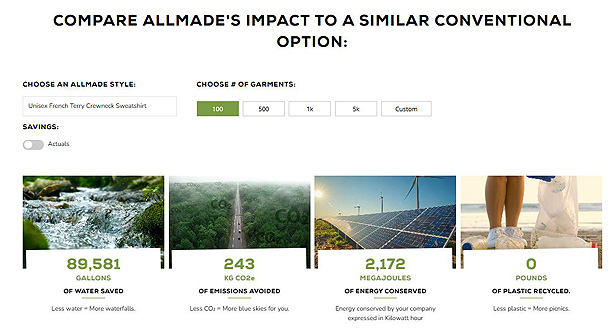
Allmade’s (asi/34341) new impact calculator is more robust than its previous version.
Q: Why did you decide to update the impact calculator?
A: Sustainability expectations have evolved significantly since we launched the original calculator. Customers are asking more sophisticated questions, and transparency standards are higher. We wanted to ensure our data, methodology and presentation reflected where the industry is today. Green Story stood out for their deep expertise in life-cycle data, credibility across retail and apparel, and ability to communicate complex impact metrics clearly and user-friendly. They helped us elevate the calculator without losing its simplicity.
2.7 billion
How many gallons of water Allmade has saved since 2016 (Source: Allmade)
Q: How did you calculate the energy and water savings for each style compared to conventional products?
A: The savings are calculated by comparing Allmade’s material blends and manufacturing processes against industry-average conventional apparel equivalents. Green Story uses verified life-cycle data and established benchmarks to assess factors such as fiber sourcing, water use, energy consumption and emissions. The goal for this update was not only to show the savings you make by choosing Allmade over conventional, but also to show the impact our shirts have on the planet. We truly believe that if it was mandatory to show your footprint per product, consumers would make MUCH better choices.
Q: Do you have any examples of how clients have used the impact calculator as a sales or marketing tool?
A: Absolutely. We’ve seen decorators use the calculator in sales presentations to differentiate bids, distributors include the savings data in proposals and brands share the results internally to support sustainability goals. In many cases, the calculator has helped turn sustainability from a “nice to have” into a deciding factor, especially when customers can clearly see the impact of choosing one shirt over another.
Q: The calculator notes that results are for informational purposes, not formal sustainability reporting. Are there plans for more formal life-cycle analyses in the future? Why or why not?
A: Our priority with the impact calculator is to provide practical, easy-to-use information that supports everyday decision-making in the promo and decoration industry. That said, we’re continually evaluating opportunities to deepen our data and improve transparency where it makes sense. At any point a customer needs further data or a look behind the curtain, we’re always willing to accommodate. After all, each year we walk customers through our factories to provide complete transparency.
Q: Anything else you can share about the new impact calculator and why it’s important?
A: The updated calculator is more robust, more transparent and easier to use than the original. It reflects better data, clearer comparisons and a more refined understanding of how impact should be communicated today. Most importantly, it reinforces what we’ve always believed: Small choices can add up to meaningful impact at scale. The calculator helps make that impact visible.

Promo for the Planet is your destination for the latest news, biggest trends and best ideas to help build a more sustainable and socially-responsible industry.