
News February 03, 2026
U.S. & India Reach Tentative Trade Deal, Bringing Tariffs Back Down to 18%
President Trump announced the agreement on Truth Social after a phone call with Indian Prime Minister Narendra Modi.
Key Takeaways
• President Trump and Prime Minister Narendra Modi announced an agreement cutting U.S. tariffs on Indian goods from 50% to 18% after months of negotiations and escalating trade tensions.
• Trump said India agreed to stop buying Russian oil, reduce trade barriers to zero and purchase more goods from the U.S. (and potentially Venezuela), prompting the rollback of previously imposed tariffs.
• The deal brings cost relief and clarity to promo companies sourcing from India – especially in apparel, jewelry and electronics – boosting optimism among promo suppliers that have increasingly turned to India as an alternative sourcing destination.
President Trump and Indian Prime Minister Narendra Modi appear to have reached a trade deal after months of tensions between the U.S. and India.
According to a post from Trump on Truth Social, India has agreed to stop buying Russian oil and will reduce trade barriers to zero, promises that led Trump to ease up on a barrage of tariffs previously imposed on the South Asian country. Modi also agreed to buy more from the U.S. and “potentially Venezuela,” Trump wrote in the post.
The trade agreement brings tariffs on Indian goods from 50% down to 18%.
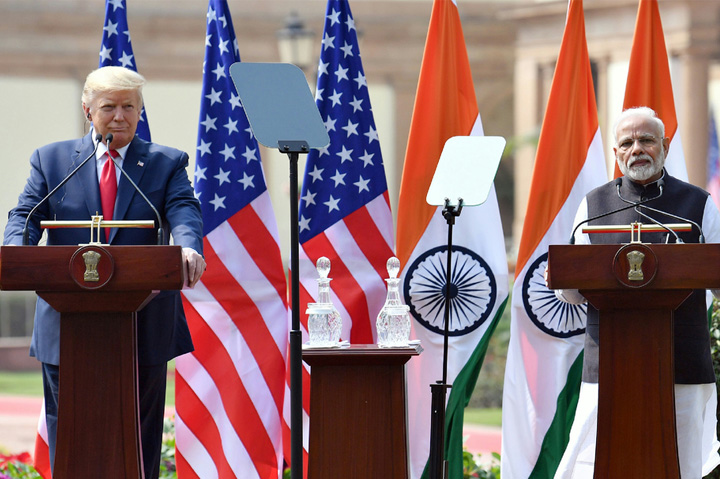
Trump and Modi reached a trade agreement on Monday, February 2, the two world leaders confirmed on social media.
Modi, for his part, is happy with the reduced tariff rate, and thanked President Trump for his cooperation in an X post.
“Delighted that Made in India products will now have a reduced tariff of 18%,” Modi wrote. “Big thanks to President Trump on behalf of the 1.4 billion people of India for this wonderful announcement. When two large economies and the world’s largest democracies work together, it benefits our people and unlocks immense opportunities for mutually beneficial cooperation.”
18%
The new tariff rate on imports from India
50%
The old tariff rate on imports from India
Months of Negotiations
The news comes after months of trade discussions between the U.S. and India. In April, President Trump imposed a 25% tariff on goods from India as part of a barrage of reciprocal tariffs on dozens of foreign nations. Then, in August, Trump signed an executive order imposing an additional 25% tariff on Indian goods due to its purchase of Russian oil.
Now, India says it will quit investing in Russian oil, but that’s a tall order: Oil from Russia comprises more than a third of the South Asian nation’s overall imports, and it brings in roughly 1.5 barrels of it every day.
Trump’s conversation with Modi, which happened over the phone on Monday morning, comes after India cut a deal with the EU on a free trade agreement, an agreement that was inked just days after Trump threatened tariffs on eight European nations in an attempt to purchase Greenland from Denmark (he has since walked back the threats).
Arvind Subramanian, a senior fellow at the Peterson Institute for International Economics and former chief economic adviser for India’s government, said Trump may have been more eager to finalize a trade deal with India as a result of Modi’s agreement with the EU.
“If India gives preferential access to the EU, U.S. business is affected,” he told CNN. “There has been a domino effect.”
Increased Clarity for Promo Suppliers of Apparel, Technology
The announcement is good news for promo companies that source textiles, jewelry and electronics, many of whom have witnessed price increases due to the spike in tariffs on Indian goods.
Sourcing in India has increased over the last year, especially as trade negotiations with China became increasingly complex. According to Counselor’s 2025 State of the Industry report, India was the fourth largest sourcing destination for promo, just behind China, Vietnam and Mexico. Several suppliers also said they planned to increase imports from India in the next three years.
“We expect to increase imports from a range of countries across Southeast Asia – like Cambodia, Vietnam and Thailand – and also from India,” said Jing Rong, vice president of supply chain and sustainability at Counselor Top 40 supplier HPG (asi/61966). “Each of these regions brings something different to the table, and together they help us spread out risk and build a more balanced supply chain.”
Now, after hearing the news about a potential tariff reduction on Indian goods, Rong is feeling optimistic.
“If this holds, it would be a very positive development, providing meaningful cost relief for some of our products that rely on India as a sourcing country,” she says.