News December 16, 2025
Newly Proposed Bipartisan Legislation Would Require Made-in-USA Merch at National Park Service Sites
The American Products in Parks Act could be a boon for American promo manufacturers.
Key Takeaways
• The American Products in Parks Act, introduced by Rep. Josh Gottheimer (D-NJ) and Rep. Jeff Hurd (R-CO), would require all merchandise sold at National Park Service gift shops to be made in the U.S., including sourcing and final assembly.
• The bill aims to boost domestic manufacturing and local economies, aligning with broader efforts to revive U.S. production and coinciding with the upcoming 250th anniversary of American independence.
• While the legislation has strong bipartisan support and could benefit American suppliers, industry experts note potential complexities in navigating NPS’s decentralized purchasing system across different regions.
During the harsh winter of 1779, George Washington’s army stopped for wood and shelter at what’s now Morristown National Historic Park in Morristown, NJ.
A couple of centuries and some years later, U.S. Congressman Josh Gottheimer returned to that same site on Dec. 8 to introduce new legislation he believes will allow the National Park Service (NPS) to continue benefiting the American people. The bipartisan bill, known as the American Products in Parks Act, was introduced by Gottheimer in partnership with Jeff Hurd, a Republican congressman from Colorado.
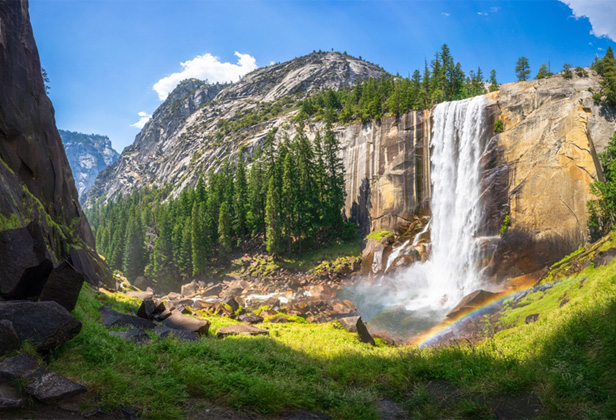
A waterfall at Yosemite National Park in California, part of the National Parks Service.
Gottheimer was joined at Morristown National Historic Park’s Jockey Hollow Visitor Center by New Jersey Manufacturing Extension Program(NJMEP) CEO Peter Connolly, Judith Fleischer of NJMEP, and Mitch Cahn, president of New Jersey-based Made-in-USA supplier Unionwear (asi/73775).
“Families who visit our parks, and feel the love of our country that so many of us share, should not have that feeling shattered when they turn over a gift and see ‘made in China’ instead of ‘made in America,’” Gottheimer said during his address. “This bill is about ensuring they don’t have to.”
The legislation mandates that products sold at National Park Service gift shops and visitor centers must meet the following criteria:
• The final assembly or processing of the product occurs in the U.S.
• All significant processing going into the product occurs in the U.S.
• All or virtually all ingredients or components of the product are made and sourced in the U.S.
America’s Best Idea
The NPS dates back to 1872, when Yellowstone was designated the world’s first national park. According to the NPS, the concept was born out of a desire and commitment to protect the country’s most iconic and historic places.
It wasn’t until almost 50 years later that President Woodrow Wilson signed the act that created the NPS as a federal agency within the Department of the Interior. In a 1983 commentary, Pulitzer Prize-winning novelist and environmentalist Wallace Stegner called the national parks “the best idea we ever had. Absolutely American, absolutely democratic, they reflect us at our best rather than our worst.”
“I think [the bill] is a great idea. But it’s a lot of cats to herd and when you get into the nitty-gritty of how you would do that, it would take a long time and would be pretty complicated.” Cary Heller, All USA Clothing (asi/30171)
Today, the NPS manages 433 areas that cover 84 million acres in all 50 states, as well as Washington, D.C., American Samoa, Guam, Puerto Rico, Saipan and the U.S. Virgin Islands. In addition to popular sites like Maine’s Acadia National Park and Yosemite in California, a number of other sites fall under the NPS umbrella – including national seashores, national lakeshores, historic monuments, battlefield sites, national parkways and more.
NPS sites have become increasingly popular over the last decade, with visitation numbers to national parks reaching a record high of 331.9 million annually in 2024. And when people visit, many of them seek out promo products – T-shirts, tote bags, pins, and stickers, to name just a few – to commemorate their trip. The NPS reported $29 billion spent in national parks and their surrounding communities in 2024.
Navigating NPS Purchasing Silos
Cary Heller, vice president of sales at All USA Clothing (asi/30171), has been partnering with the NPS for years. He says his company could see significant growth if the American Products in Parks Act passes. But while Heller says the legislation makes a lot of sense in theory, he has concerns about its practical implementation.
All USA Clothing’s products and designs are sold at dozens of NPS sites, including the Wright Brothers National Monument, Flight 93 NM, Homestead NM, Saratoga NP, Wilson’s Creek NP and Sleeping Bear Dunes NP. However, its business is mostly confined to NPS sites in the Eastern part of the U.S. due to complexities that exist within the NPS buying process.
"The East is run by one association, and they handle most of the parks from the middle all the way to the East Coast,” says Heller. “And then there’s a different buying association that handles the other parks on the Western side. They operate completely independent of one another.”
That adds complexity to the process.
“I think [the bill] is a great idea,” says Heller. “But it’s a lot of cats to herd and when you get into the nitty-gritty of how you would do that, it would take a long time and would be pretty complicated.”
If the act is signed into law, Heller says it would ultimately be good for his business, especially as an already trusted NPS partner.
“We could see some of the bigger parks in the Western part of the country start to come to us, and we could increase the amount of business and the number of parks that we work with because we’re one of the larger, more trusted vendors to the park already,” he adds.
A Growing Push Toward Domestic Production
The proposed legislation could be a boon to the American manufacturing and local economies throughout the country, Gottheimer said. The congressman also noted that more than half of products sold at national park stores are made by foreign manufacturers (though the latest data available is over 15 years old).
The legislation comes after the Trump Administration has repeatedly called for a return to U.S. manufacturing. The president initially imposed tariffs to create jobs, though critics of these levies said they would instead lead to higher prices, as the cost of labor in the U.S. is significantly more expensive than it is in foreign countries like China and Vietnam.
The announcement of the bill also falls on the heels of the Declaration of Independence’s 250th anniversary in July 2026 – less than a year away. Promo companies are already gearing up for the celebration, and many of the promotional products surrounding the bicentennial will be manufactured domestically (which is by design, given it’s a celebration of American independence).
“[America] 250 is a very good opportunity for the industry, because if a company does 250 promo, it’s going to be kept forever,” says Cahn of Unionwear. “It’s also going to be one of the first times that a lot of companies consider having their promotional products made in USA, because they want to avoid sending a mixed message about congratulating the country on its 250th birthday and doing it with a promotional product that’s made in China.”
The proposed legislation is a similar nod to American patriotism, with the goal of preserving the country’s economy the way it has preserved its parks.
“We don’t have to make everything, but we must have the ability to make things for our country when we need them.” Mitch Cahn, Unionwear (asi/73775)
Cahn notes that half of Unionwear’s business comes from the federal government, specifically the Department of Defense. He says his company and others would likely be out of business without a piece of legislation called the Berry Amendment, which requires the DoD to prioritize domestically produced textiles, food and clothing. In 2009, Cahn partnered with democratic congressmen Barney Frank and John Kerry of Massachusetts on a new procedure that requires contracts exceeding $150,000 for promotional wearables purchased by the DoD – such as giveaways used in military recruiting – to adhere to the Berry Amendment.
“Before that change, most of the promotional products were not made in America,” Cahn says. “After that change, not only have those products been made in America, but that’s been very seriously enforced by the Department of Defense.” He is hoping for a similar type of change at NPS.
But for Cahn, prioritizing American manufacturing isn’t just good for business – it’s also a matter of national security. “We wouldn’t have the ability to make protective gear for our armies if we’d have to rely on another country to do it for us,” he says. He adds that during the COVID-19 pandemic, when people couldn’t get masks and other protective gear, domestic textile manufacturers made these products for Americans who needed them.
“This is the one thing that the federal government can do to keep the domestic textile business alive,” Cahn says. “It’s important that we make our own things in the country. We don’t have to make everything, but we must have the ability to make things for our country when we need them.”
By the Numbers
• The National Park Service manages 433 areas that cover 84 million acres in all 50 states, as well as Washington, D.C., American Samoa, Guam, Puerto Rico, Saipan and the U.S. Virgin Islands.
• In 2024, 331.9 million national park visits were reported, and visitors spent $29 billion in the parks and surrounding communities.
Legislation That Reaches Across the Political Aisle
Cahn, whose company has gained mainstream attention for manufacturing Republican and Democratic presidential campaign hats, is confident that the American Products in Parks Act will succeed in part because of its bipartisan backing. In 2013, Sen. Kristen Gillibrand of New York introduced an identical bill cosponsored by four other Democratic senators, but the proposed legislation ultimately did not pass. Cahn believes Gottheimer’s proposed bill will be more successful given its Republican co-sponsorship.
For Gottheimer, the bipartisan bill is about collaborating to find a solution to a challenge that impacts Americans, regardless of their political beliefs.
“We must work together to preserve these natural treasures for our future generations – there is nothing partisan about it,” he said during his address. “Our parks aren’t red or blue; they are red, white and blue. And today’s bipartisan legislation will help ensure that.”
Regardless of what happens with the American Products in Parks Act, Heller plans to keep doing what he’s been doing all along: manufacturing American-made goods for America’s most iconic places.
“When I see a purchase order coming for Harriet Tubman National Monument, I feel good that we designed the artwork for those shirts,” Heller says. “I feel proud, I feel a sense of accomplishment, and I feel a huge sense of trust that’s put into us to make those T-shirts, and to make sure that they’re done in a way that respects that park and the person and what they’ve done.”